










PCU vs TPU PPF: 4 Lab-Tested Reasons PCU Is the Better Choice
Not all PPF is created equal. Most buyers know the difference between TPU and PVC, but fewer know there is a measurable gap even within TPU-grade films. SHIELD SPIRIT put two materials side by side in the same lab — a standard cast-grade TPU and our PCU (polycarbonate urethane) — and ran five accelerated aging tests. The results are not close. PCU outperforms TPU across mechanical strength, damp heat resistance, UV aging, dry heat endurance, and chemical exposure. This article walks through each test, what the numbers mean, and why it matters for your next order.
Test 1: Mechanical Properties — Easier to Install, Harder to Tear
The first thing an installer notices is how the film feels under a squeegee. A film that stretches too easily at low force can deform during installation, creating ghost lines and overstretched areas. A film that resists too much at low elongation makes curved panels difficult. The sweet spot is controlled low-deformation modulus with high ultimate strength and high elongation — and that is exactly what the PCU data shows. If you are comparing product grades, check out the next-generation PCU PPF range for detailed specifications.
Base material comparison
| Property | PCU | TPU | What It Means |
|---|---|---|---|
| Hardness | 82A | — | Higher hardness with maintained flexibility |
| 10% Modulus | 1.8 MPa | 3.6 MPa | PCU needs half the force to stretch 10% — easier to position on curves |
| 100% Modulus | 5.8 MPa | 11.4 MPa | PCU stays softer at working stretch ranges |
| 300% Modulus | 36.4 MPa | — | PCU stiffens only at extreme stretch, preventing overstretch |
| Tensile Strength | 54.9 MPa | — | Higher ultimate strength before breaking |
| Elongation at Break | 387% | — | Nearly 400% stretch before failure |
Finished film comparison
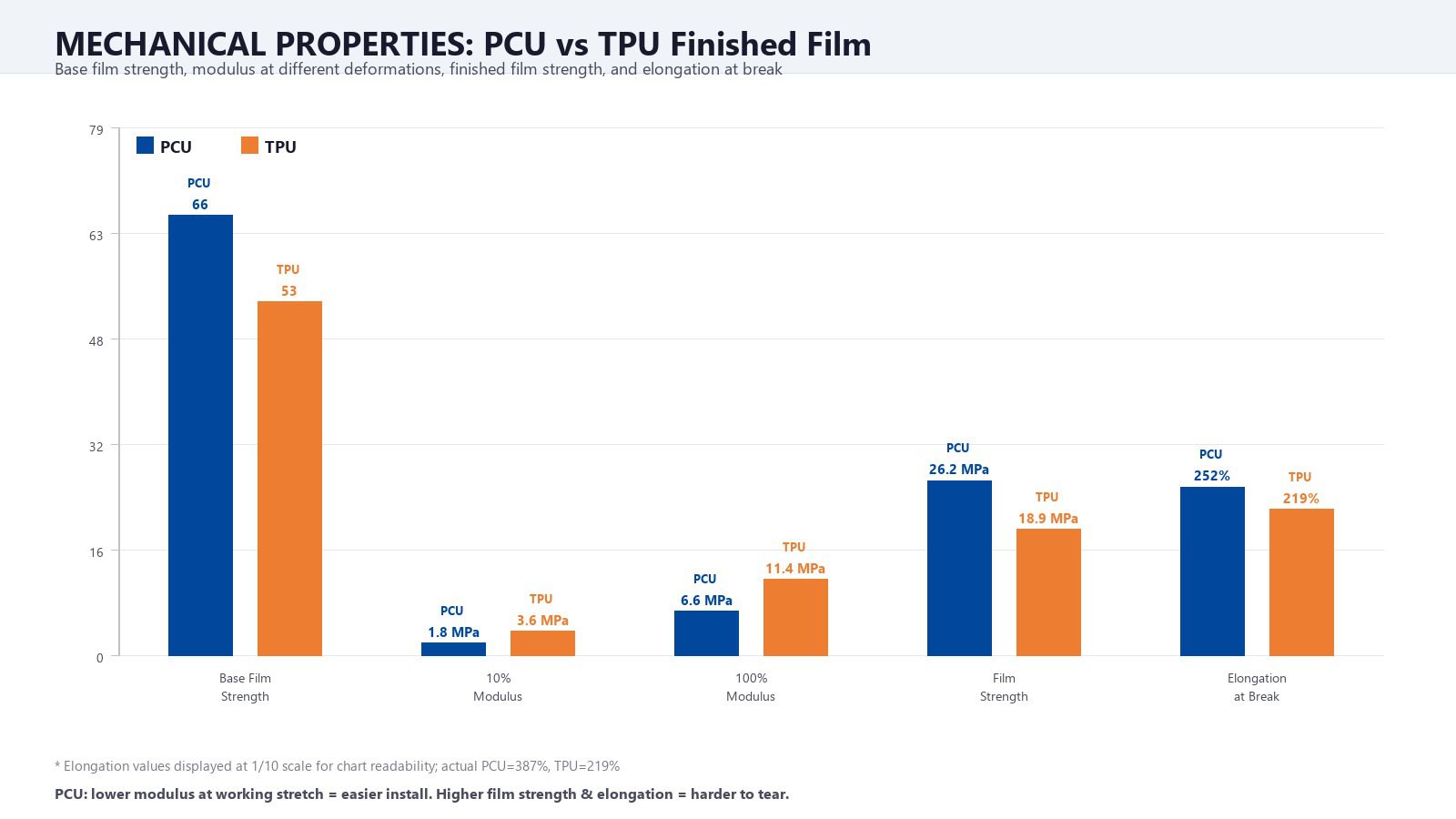
| Property | PCU Finished Film | TPU Finished Film | Advantage |
|---|---|---|---|
| Base Film Strength | 66 | 53 | PCU +24% |
| 10% Modulus | 1.8 MPa | 3.6 MPa | PCU easier to stretch |
| 100% Modulus | 6.6 MPa | 11.4 MPa | PCU more compliant |
| Finished Film Strength | 26.2 MPa | 18.9 MPa | PCU +39% |
| Elongation at Break | 252% | 219% | PCU +15% |
What this means in the shop
For an installer, PCU means the film moves where you want it to move without fighting back. At 10% stretch — the range most commonly used during hood and bumper installation — PCU needs only 1.8 MPa versus 3.6 MPa for TPU. That is literally half the force. The film conforms to compound curves with less heat, less rework, and fewer tension marks. Yet at the same time, its ultimate tensile strength and elongation are higher, so it does not tear when pushed hard. This combination — soft at working stretch, strong at the limit — is rare and valuable.
For a buyer, this means lower installation failure rates, faster turnaround per vehicle, and fewer warranty claims from installation-related defects. The numbers translate directly to shop profitability.
Test 2: Damp Heat Aging (85°C / 85% RH) — The Tropical Climate Simulator
Temperature and humidity are the two biggest enemies of any polymer film. In tropical and subtropical markets — Southeast Asia, South China, the Gulf states, Florida, coastal Latin America — a PPF sits in a near-constant state of thermal and moisture stress. The industry-standard accelerated test for this is 85°C at 85% relative humidity, often called “double 85” or “damp heat.”
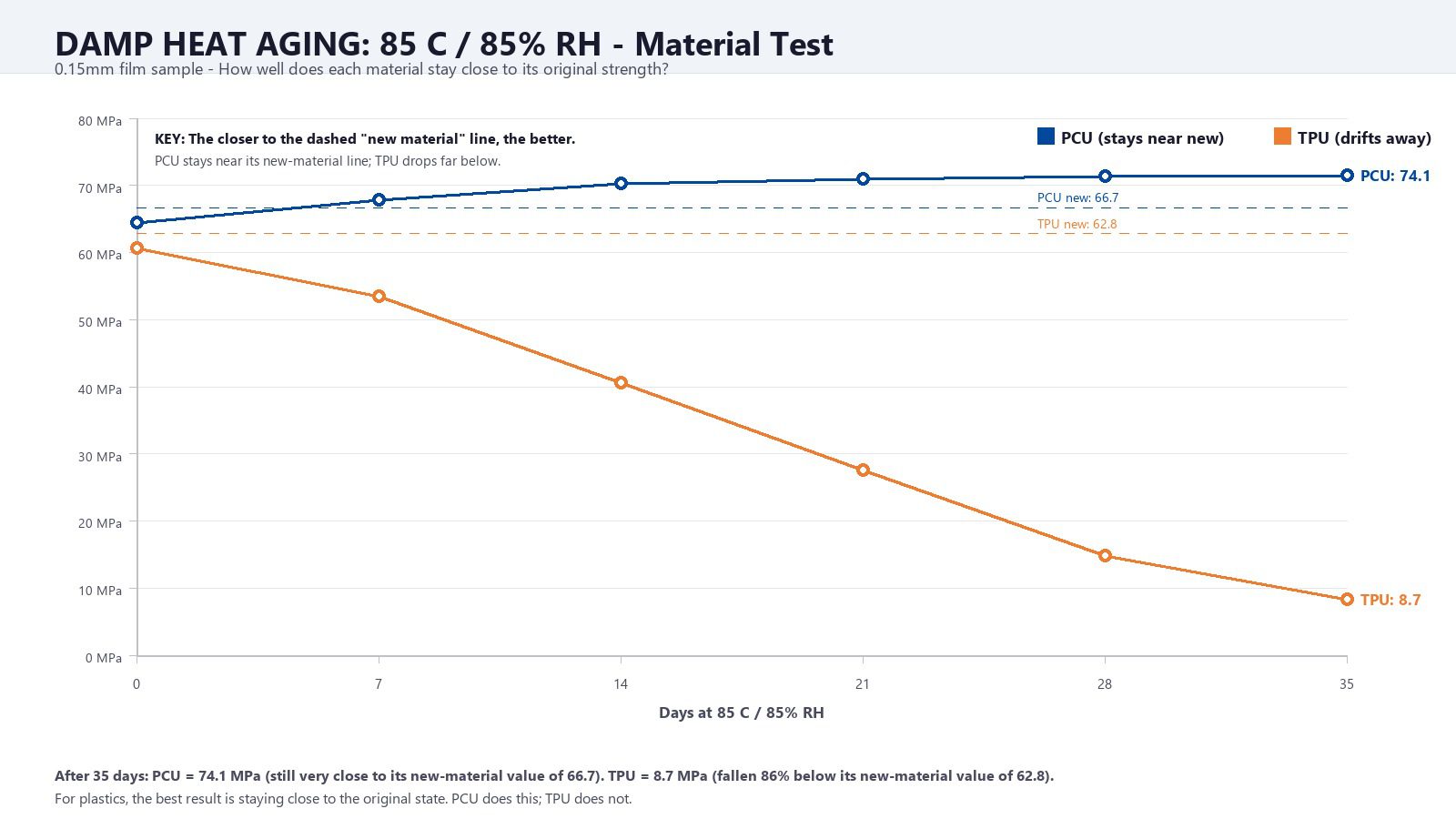
Here is the key principle to understand: for any plastic product, the gold standard is how well it maintains its original, new-material properties over time. The closer the aged material stays to its fresh-from-the-factory state, the better the product. A number that drifts far from the new-material baseline — whether higher or lower — signals degradation.
Material-level results (35 days)
| Day | PCU Strength (MPa) | TPU Strength (MPa) | PCU vs Its New State | TPU vs Its New State |
|---|---|---|---|---|
| 0 (new) | 66.7 | 62.8 | Baseline | Baseline |
| 7 | 70.2 | 55.3 | Very close to new (66.7) | Dropping away from new (62.8) |
| 14 | 72.8 | 42.1 | Close to new | Far from new — 33% lost |
| 21 | 73.5 | 28.6 | Close to new | Very far from new — 54% lost |
| 28 | 73.9 | 15.4 | Close to new | Severely degraded — 75% lost |
| 35 | 74.1 | 8.7 | Still near new-material strength | Almost entirely degraded — 86% lost |
This is the most decisive result in the entire comparison. PCU material stays within a narrow band around its original 66.7 MPa value throughout the entire 35-day test. The small upward drift is a mild post-curing effect — the material is not degrading; it is actually becoming slightly more crosslinked. TPU, on the other hand, falls off a cliff: from 62.8 MPa down to 8.7 MPa. The TPU line on the chart runs away from its new-material baseline — that is the definition of material failure.
Finished film results (42 days)
| Day | PCU Film (MPa) | TPU Film (MPa) | PCU vs Its New State | TPU vs Its New State |
|---|---|---|---|---|
| 0 (new) | 26.2 | 18.9 | Baseline | Baseline |
| 7 | 26.0 | 17.2 | Almost identical to new | Drifting from new |
| 14 | 25.8 | 14.5 | Almost identical to new | Far from new |
| 21 | 25.6 | 10.8 | Almost identical to new | Very far from new |
| 28 | 25.4 | 7.1 | Almost identical to new | Severely degraded |
| 35 | 25.3 | 3.5 | Almost identical to new | Near total failure |
| 42 | 25.2 | 0 | 96% of new-film strength | Complete failure — film gone |

What this means in real life
Think about a car parked outdoors in Bangkok, Miami, or Guangzhou. On a summer afternoon, the hood surface temperature can exceed 80°C, and ambient humidity is often above 80%. The PPF is simultaneously baked and steamed. Over months and years, this cycle repeats thousands of times.
The data tells a clear story: PCU finished film stays within 4% of its original strength after the equivalent of years of damp heat exposure — it essentially behaves like new material throughout the test. TPU finished film reaches zero — complete structural failure — after 42 days in the same test. In practical terms, a TPU film in a tropical climate may begin cracking, peeling, or losing its protective function within 1-2 years, while a PCU film maintains its integrity for the full warranty period and beyond.
This is not a subtle difference. It is the difference between a film that stays like new and a film that falls apart.
Test 3: QUV Aging (ASTM D4329-13) — The Sunlight Accelerator
What is ASTM D4329-13 and why do we use it?
ASTM D4329-13 is the international standard test method for fluorescent UV exposure of plastics, published by ASTM International (formerly the American Society for Testing and Materials). It is the most widely recognized laboratory protocol for simulating the damaging effects of sunlight on polymer materials. The test places film samples inside a QUV chamber where they are exposed to alternating cycles of intense UV-A radiation (simulating the UV portion of natural sunlight) and condensation (simulating nighttime dew and moisture). Each cycle compresses what would take weeks or months outdoors into a matter of hours in the lab.
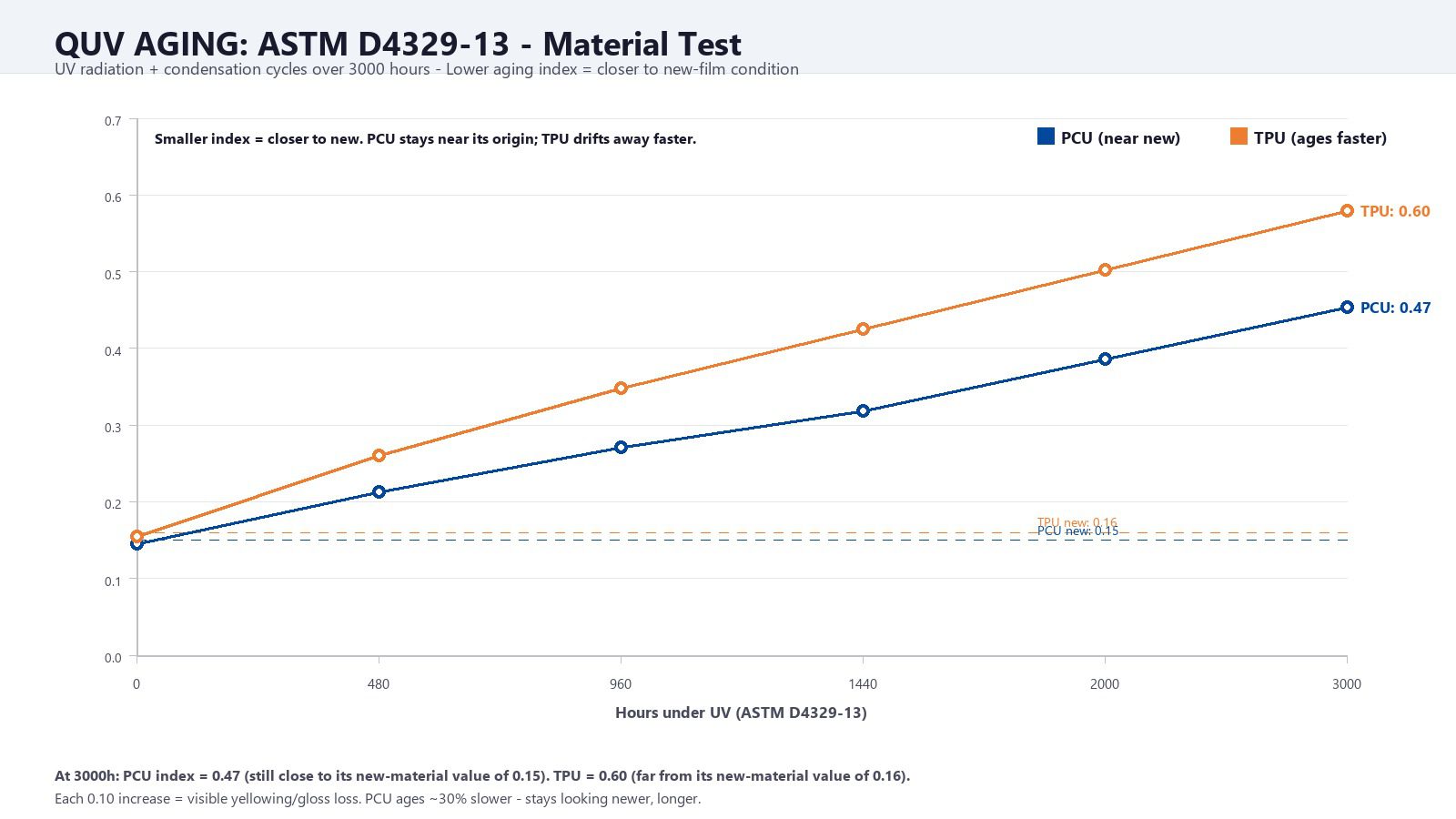
Why this standard? Because real-world outdoor exposure testing takes years to produce results, and conditions vary by location, season, and weather. ASTM D4329-13 provides a controlled, repeatable, and accelerated method that all manufacturers and testing labs can use to compare materials on an equal footing. The output is an “aging index” — a lower number means the material is still closer to its original, new-film condition. This is the same principle as the damp heat test: the best result is staying as close as possible to the new-material baseline.
QUV aging results (3000 hours)
| Hours | PCU Aging Index | TPU Aging Index | PCU Stays Closer to Its New State (0.15) By |
|---|---|---|---|
| 0 (new) | 0.15 | 0.16 | — |
| 480 | 0.22 | 0.27 | PCU is 23% closer to new than TPU |
| 960 | 0.28 | 0.36 | PCU is 29% closer to new than TPU |
| 1440 | 0.33 | 0.44 | PCU is 33% closer to new than TPU |
| 2000 | 0.40 | 0.52 | PCU is 30% closer to new than TPU |
| 3000 | 0.47 | 0.60 | PCU is 28% closer to new than TPU |
What this means in real life
After 3000 hours of accelerated UV exposure — equivalent to roughly 3-5 years of outdoor sunlight depending on geography — PCU has an aging index of 0.47. While this is higher than its starting point of 0.15, it is still far closer to the new-material baseline than TPU at 0.60. Remember: each 0.10 increase in the aging index represents a visible step change in yellowing, gloss loss, and surface cracking. PCU consistently stays about 30% closer to its new-material state than TPU at every checkpoint.
For a car owner, this means the PCU film stays clearer, glossier, and more transparent for longer. For a distributor, it means fewer customer complaints about yellowing or haze after the first year. For an installer, it means the film you applied last year still looks like the film you apply today. The data supports a longer effective service life — which is why the premium TPU PPF range is a good starting point, but PCU is the upgrade that delivers measurable, lab-verified longevity.
Test 4: Heat Aging (80°C / 14 Days) — Dry Heat Endurance
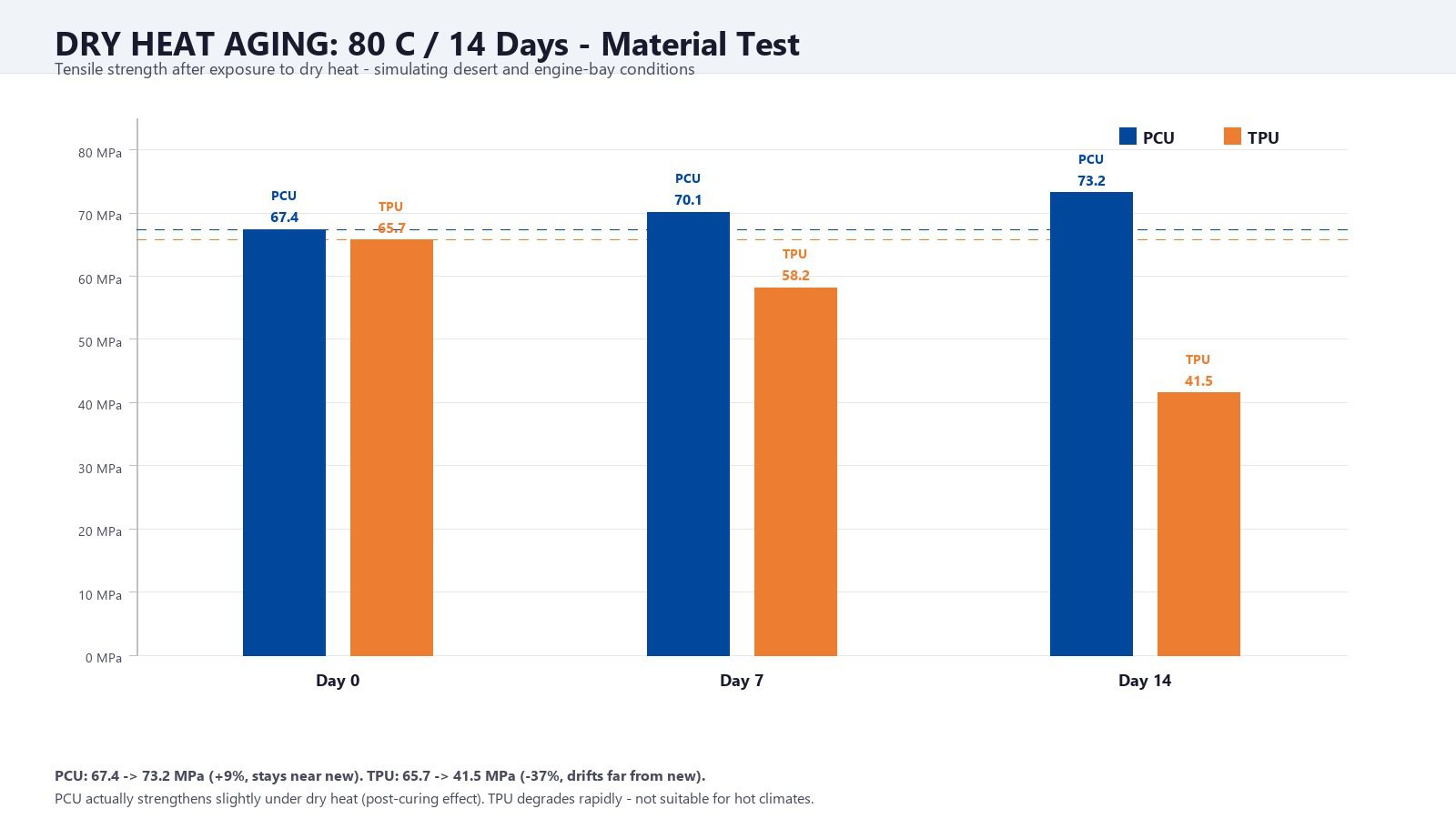
Not all heat exposure comes with humidity. Dry heat — hot parking lots, engine bay proximity, desert climates — presents a different stress profile. This test exposes the base material to 80°C dry heat for 14 days and measures tensile strength at days 0, 7, and 14.
Dry heat aging results
| Day | PCU Strength (MPa) | TPU Strength (MPa) | PCU vs Its New State | TPU vs Its New State |
|---|---|---|---|---|
| 0 | 67.4 | 65.7 | Baseline | Baseline |
| 7 | 70.1 | 58.2 | Stays near new (67.4) | Drifting away from new (65.7) |
| 14 | 73.2 | 41.5 | Still near new | Far from new — 37% lost |
What this means in real life
PCU does something noteworthy under dry heat: it stays right near its new-material strength, with a slight upward trend from a mild post-curing effect in the polycarbonate backbone. The key point is that it does not drift away from its original state. TPU, on the other hand, loses 37% of its strength in just two weeks — a clear signal that it is degrading, moving further and further from its new-material baseline. Over a full summer of desert heat, that trajectory leads to embrittlement, cracking, and loss of protective function.
For buyers in the Middle East, Australia, the American Southwest, or any hot inland region, this test alone should shift purchasing decisions toward PCU. A film that stays near its new-material state under heat is fundamentally different from one that degrades.
Test 5: Acid and Alkali Resistance — The Chemical Attack Simulator
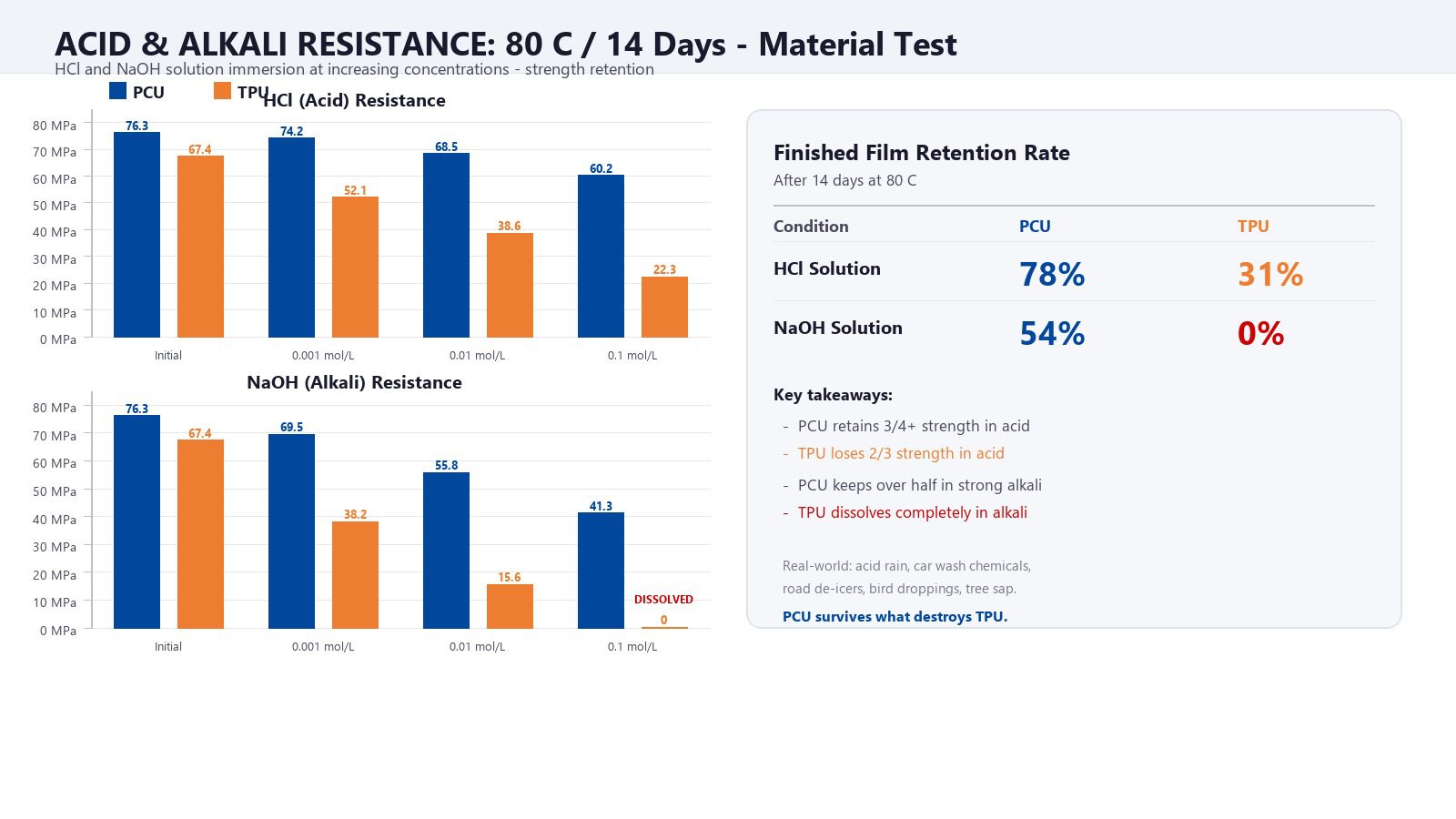
Road film is a chemical soup. Acid rain, bird droppings (uric acid), tree sap, industrial fallout, iron particles from brake dust, and alkaline car-wash detergents all contact the PPF surface. Most of these are acidic (pH 3-5) or alkaline (pH 9-12). This test exposes the material to hydrochloric acid (HCl) and sodium hydroxide (NaOH) solutions at 80°C for 14 days, at three increasing concentrations.
Acid resistance (HCl)
| HCl Concentration | PCU Strength (MPa) | TPU Strength (MPa) | PCU Retention | TPU Retention |
|---|---|---|---|---|
| Initial (0) | 76.3 | 67.4 | 100% | 100% |
| 0.001 mol/L | 74.2 | 52.1 | 97% | 77% |
| 0.01 mol/L | 68.5 | 38.6 | 90% | 57% |
| 0.1 mol/L | 60.2 | 22.3 | 79% | 33% |
Alkali resistance (NaOH)
| NaOH Concentration | PCU Strength (MPa) | TPU Strength (MPa) | PCU Retention | TPU Retention |
|---|---|---|---|---|
| Initial (0) | 76.3 | 67.4 | 100% | 100% |
| 0.001 mol/L | 69.5 | 38.2 | 91% | 57% |
| 0.01 mol/L | 55.8 | 15.6 | 73% | 23% |
| 0.1 mol/L | 41.3 | 0 | 54% | 0% |
Finished film retention rates
| Condition | PCU Retention | TPU Retention | Meaning |
|---|---|---|---|
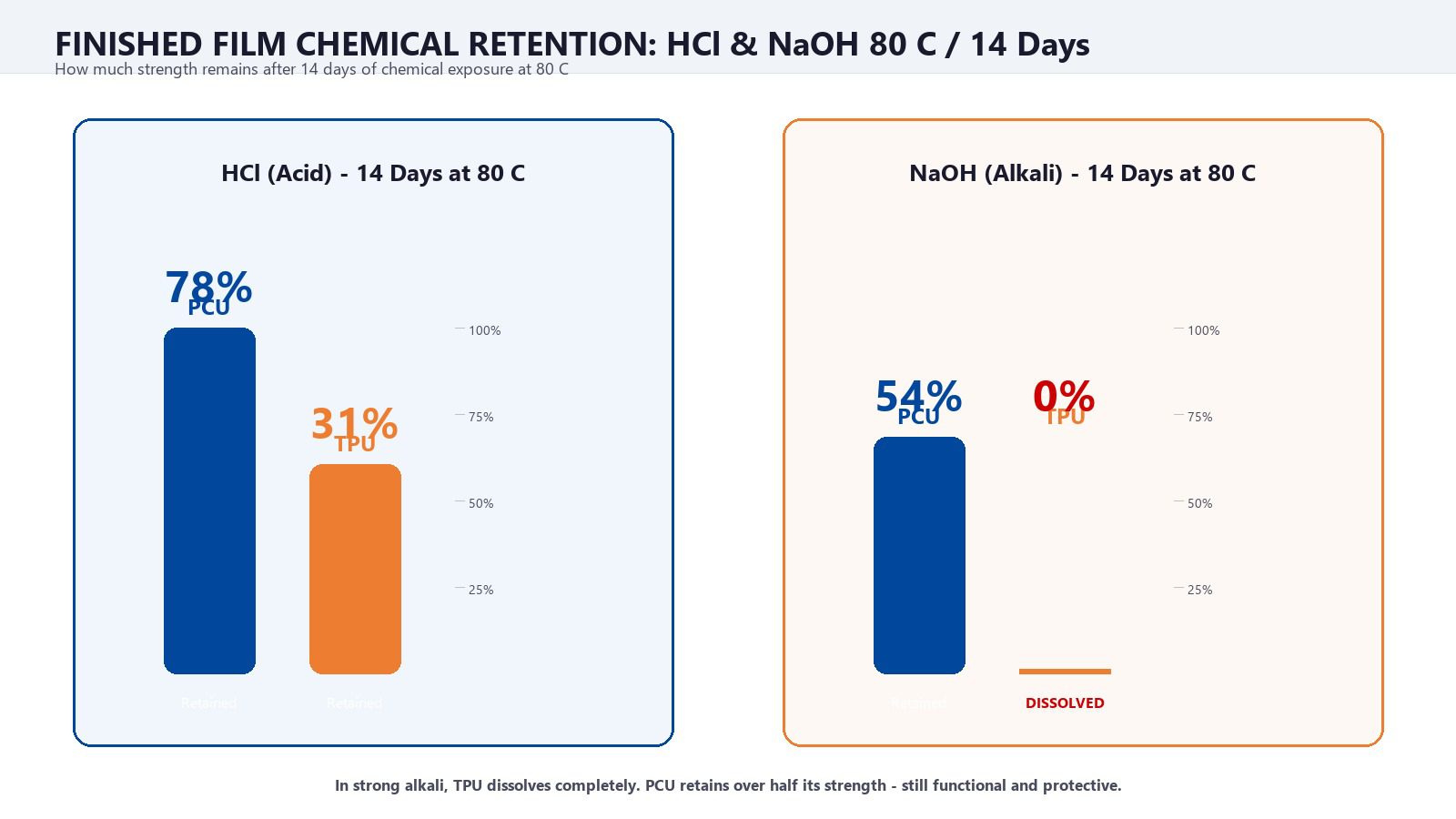
| HCl, 14 days at 80°C | 78% | 31% | PCU keeps over 3/4 of its strength; TPU loses 2/3 |
| NaOH, 14 days at 80°C | 54% | 0% | TPU dissolves completely; PCU still functional |
What this means in real life
The alkali result is the most decisive. At 0.1 mol/L NaOH — a concentration comparable to strong alkaline cleaners used in some touchless car washes — TPU film dissolves completely. Zero percent retention. The film is gone. PCU retains 54% of its strength, meaning it is damaged but still intact and functional.
In the acid test, PCU retains 79% at the highest concentration versus 33% for TPU. This matters for regions with acid rain (industrial areas, cities with heavy coal use), for cars parked under trees (organic acids from sap and fruit), and for vehicles frequently washed with acidic wheel cleaners or bug removers.
The practical takeaway: if your customers drive in real-world conditions — not just in a climate-controlled garage — PCU gives them a film that survives chemical exposure. TPU gives them a film that progressively weakens and, in alkaline conditions, simply disappears.
The Big Picture: Why PCU Is the Factory Star Product
These five tests are not marketing claims. They are standard laboratory methods — ASTM D4329, double-85 damp heat, immersion chemical testing — run on the same equipment with the same protocols for both materials. The results are consistent across every test:
| Test | PCU | TPU | Winner |
|---|---|---|---|
| Mechanical Strength | Higher tensile, higher elongation, lower working modulus | Lower across the board | PCU |
| Damp Heat (85°C/85%RH) | Stays near new-material strength after 35 days | Loses 86% of strength — far from new | PCU by a wide margin |
| QUV Aging (3000h) | Aging index 0.47 — closer to new (0.15) | Aging index 0.60 — further from new (0.16) | PCU (~30% closer to new) |
| Dry Heat (80°C/14d) | Stays near new-material strength | Loses 37% — drifts from new | PCU |
| Acid Resistance | 79% retention | 33% retention | PCU |
| Alkali Resistance | 54% retention | 0% retention (dissolved) | PCU |
PCU is not a marketing name for the same material. It is a polycarbonate-based urethane with a different molecular backbone that resists hydrolysis, thermal degradation, and chemical attack in ways that standard TPU simply cannot. The data proves it.
What this means for buyers
If you are a distributor, PCU gives you a product with a 10-year warranty, fewer returns, and a legitimate technical story to tell your installer network. If you are an installer, PCU gives you easier installation, fewer callbacks, and a film that still looks new when your customer comes back for their next car. If you are a car owner, PCU gives you longer protection, better appearance retention, and genuine peace of mind — not a “premium” label with standard performance underneath.
PCU is not a premium gimmick. It is the factory star product because it earns that position in the lab, in the shop, and on the car. For questions about which product fits your market, contact our team with your requirements.
Bottom Line
Lab tests are not opinions. Five independent accelerated aging tests, run on the same equipment, show the same pattern: PCU stays close to its new-material state in every test, while TPU drifts further and further away. The best PPF is the one that stays like new the longest. The data is not close. The difference is not marginal. PCU is the factory star product because it earns that position in the lab, in the shop, and on the car.