








TPU مقابل PCU PPF: ما الفرق الحقيقي؟
قارن بين أغشية الحماية من الصدمات (PPF) المصنوعة من مادة TPU الفاخرة وتلك المصنوعة من مادة PCU عالية الجودة، باستخدام بيانات معملية حقيقية لأغشية جاهزة. تعرف على المعنى الفعلي لمصطلحات اللمعان، والضبابية، والخصائص المقاومة للماء، والإصلاح الحراري بالنسبة لسيارتك.
Why This Comparison Matters
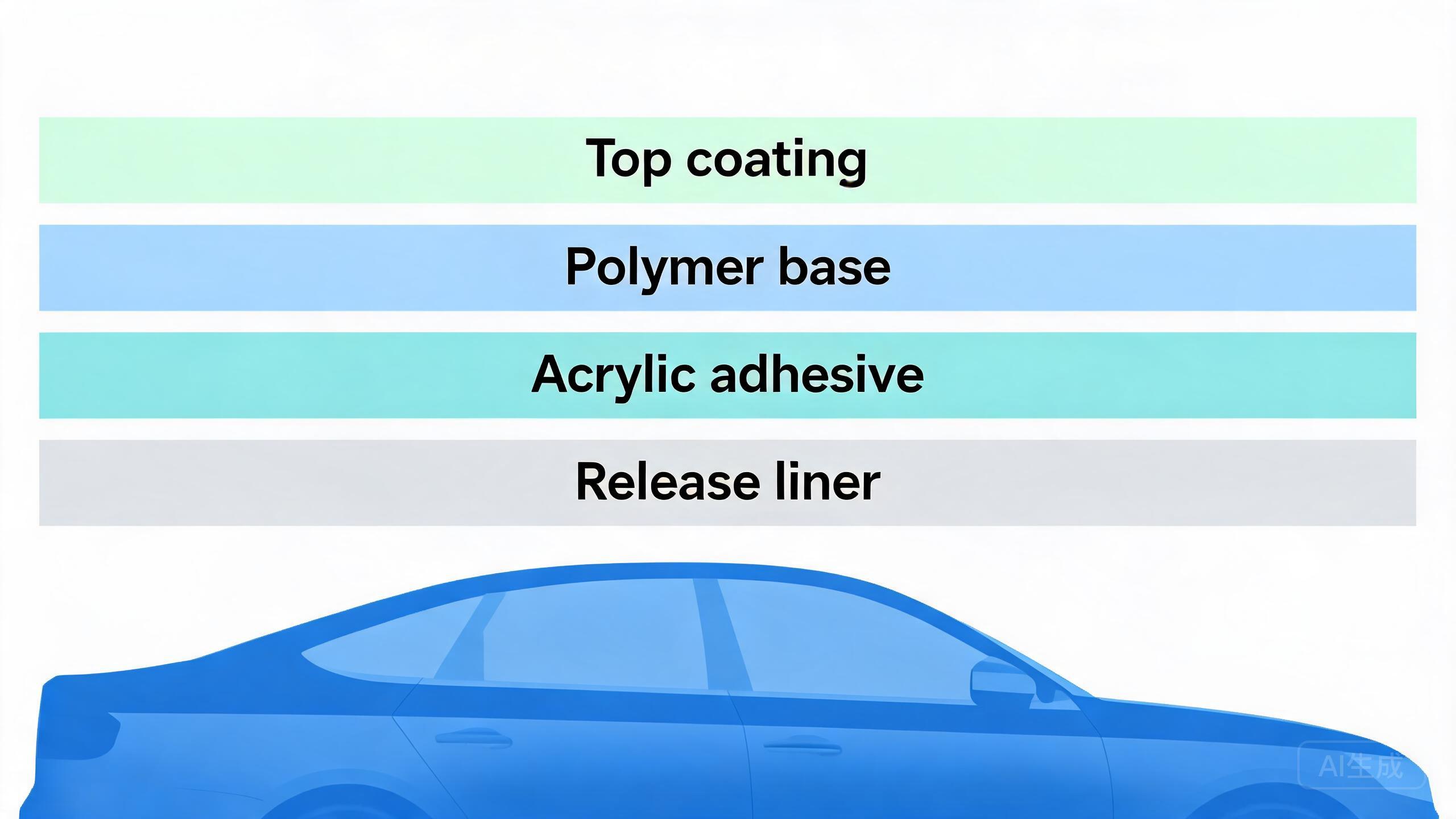
Many buyers hear “TPU” and “PCU” as if they were two simple labels. In practice, the result depends on the complete formula and process: the base polymer, film forming, top coating, stabilizers, adhesive, release liner and installation conditions all affect what the driver sees after installation.
That is why this article compares two finished transparent PPF products from the same manufacturing system. The premium TPU product represents the GS series. The higher-end PCU product represents the PCT series. Both were tested on August 26, 2026, and both reports concluded “Pass.”
TPU and PCU in Plain English
TPU is a polyurethane-based material family known for flexibility, toughness and stretch. Those qualities help a film follow curved body panels and absorb the small impacts, rubbing and road debris that a car meets every day.
PCU is used here as SHIELD SPIRIT’s higher-end PPF material route. It still needs to be judged as a finished multilayer film, but the product-level data show a more refined balance of thinness, gloss, water behavior, surface cleanliness and mechanical performance.
This does not mean that every product carrying a TPU or PCU label will perform the same way. A buyer should always request the product code, construction, test method, test date, warranty, TDS and COA. Material names are a starting point; finished-film data are the decision point.
The Laboratory Snapshot: TPU vs PCU Finished-Film Data
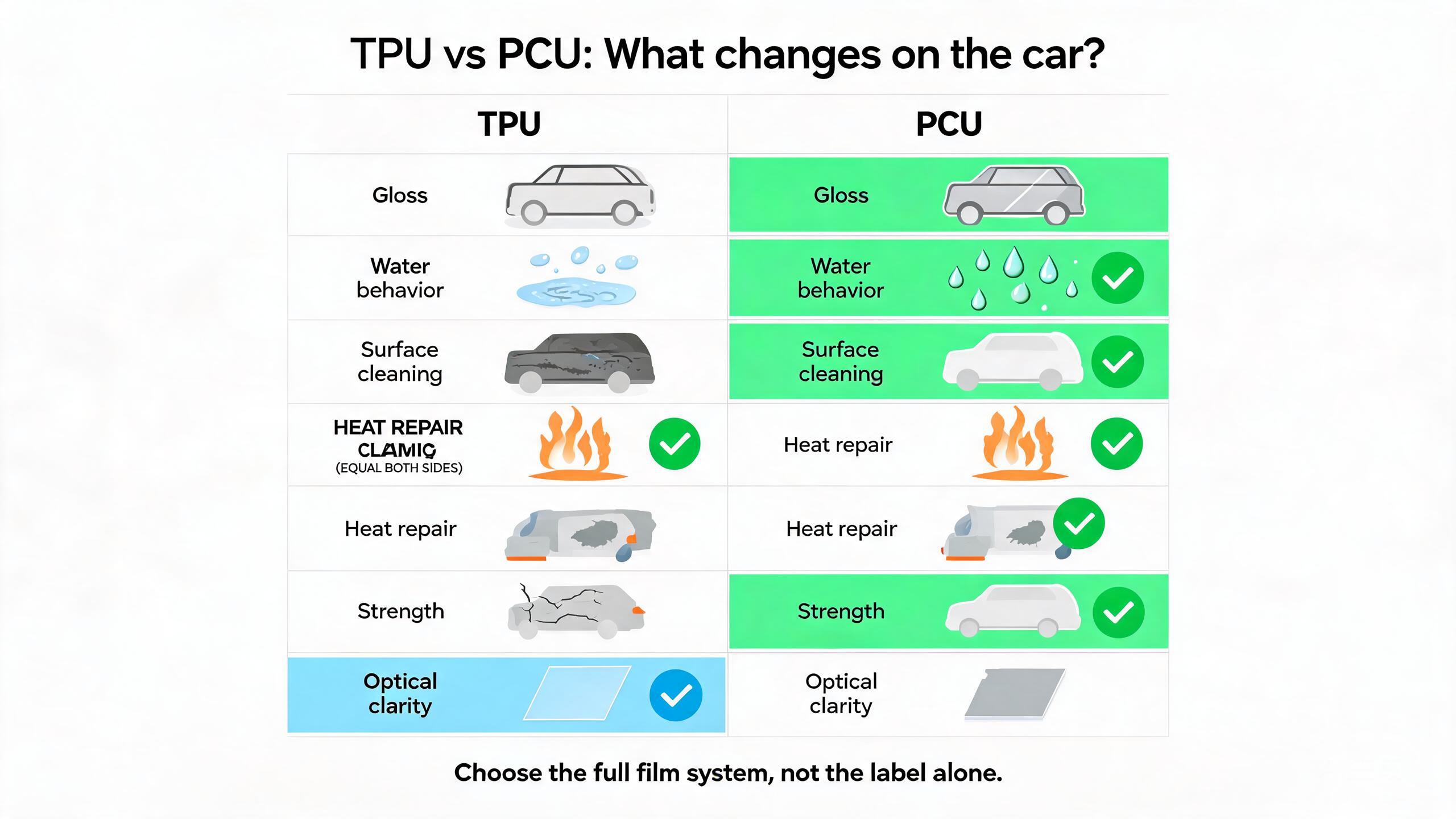
The two products were tested at the same nominal 7.5 mil class. The most visible difference is not a dramatic change in every number. It is a cluster of small but practical advantages on the PCU film, especially at the surface.
| Finished-film item | Premium TPU (GS series) | Higher-end PCU (PCT series) | What it means in daily life |
|---|---|---|---|
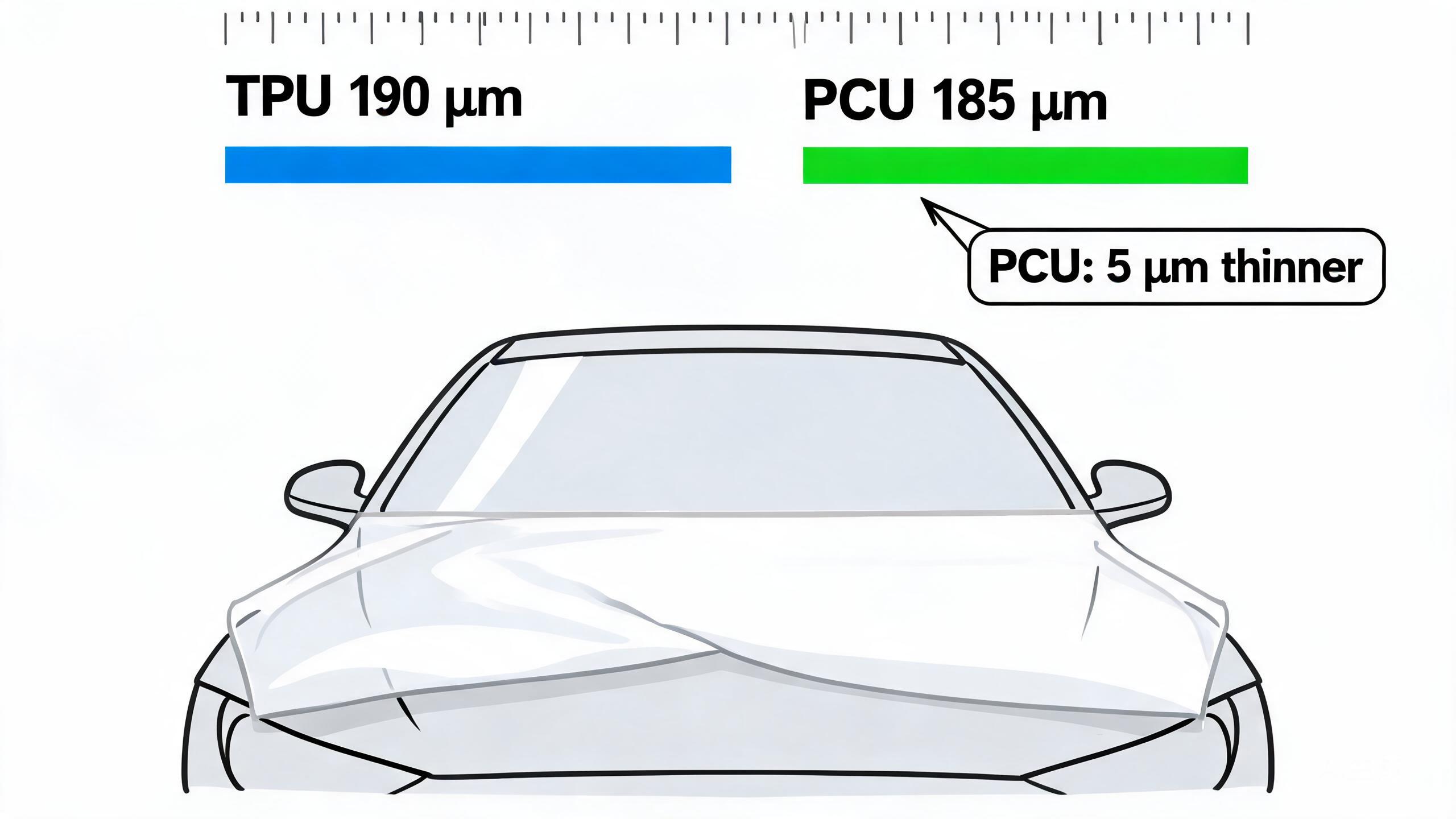
| Finished thickness | 190 um | 185 um | PCU is 5 um thinner. Edges and complex curves look less bulky. |
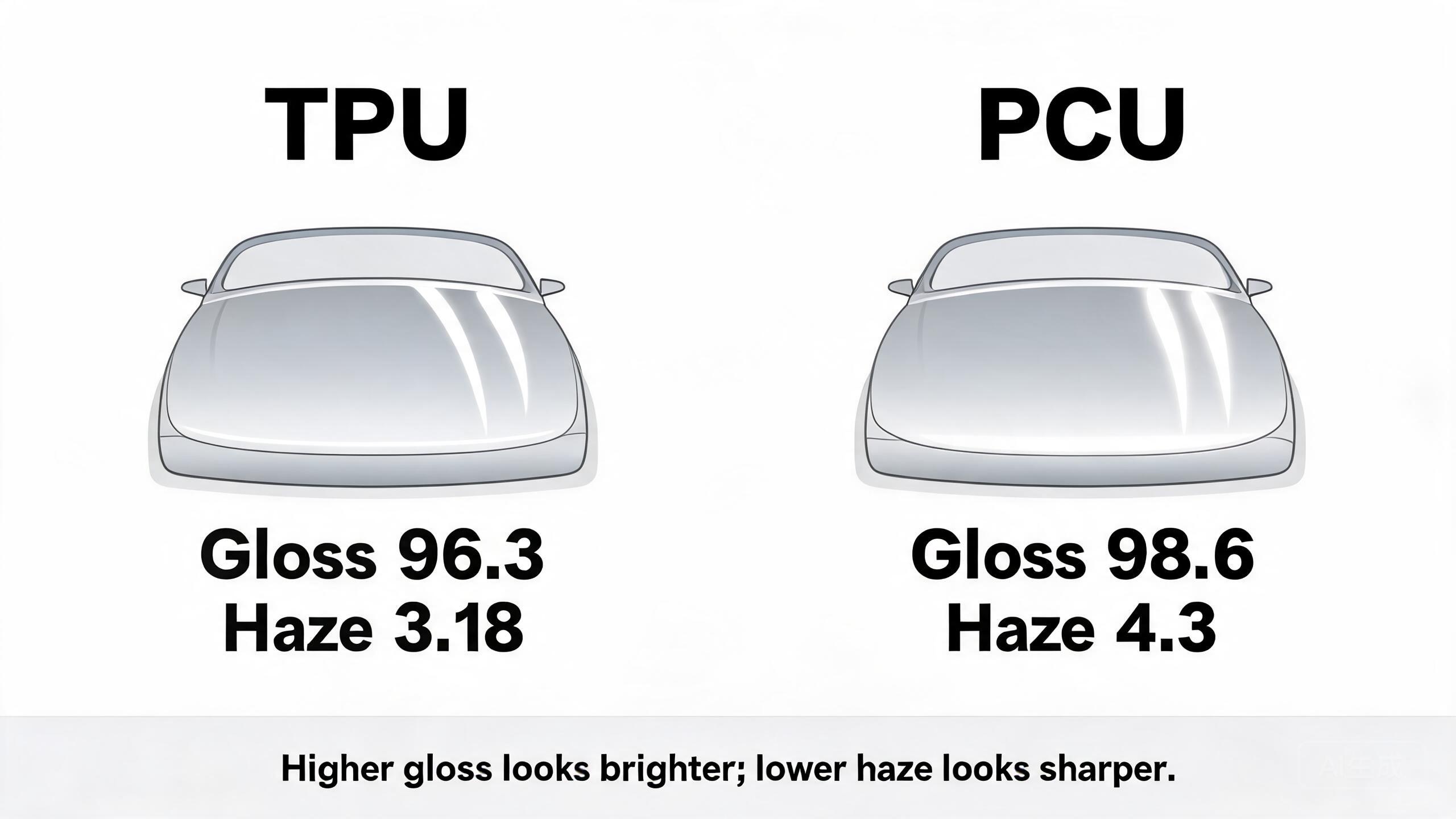
| Gloss | 96.3 | 98.6 | PCU gives a brighter, more mirror-like reflection. The paint looks more “wet”. |
| Haze | 3.18 | 4.3 | TPU measured slightly clearer. A small optical trade-off, not a reason to call PCU cloudy. |
| Visible light transmission | 89.4% | 89.84% | Both are highly transparent. Original paint color shows through clearly. |
| UV blocking | 91.8% | 91.5% | TPU was marginally higher. Small difference; verify with warranty and test method. |
| QUV aging result | Delta E*ab 1.5 | Delta E*ab 1.5 | Identical color-difference result. Both age well under accelerated testing. |
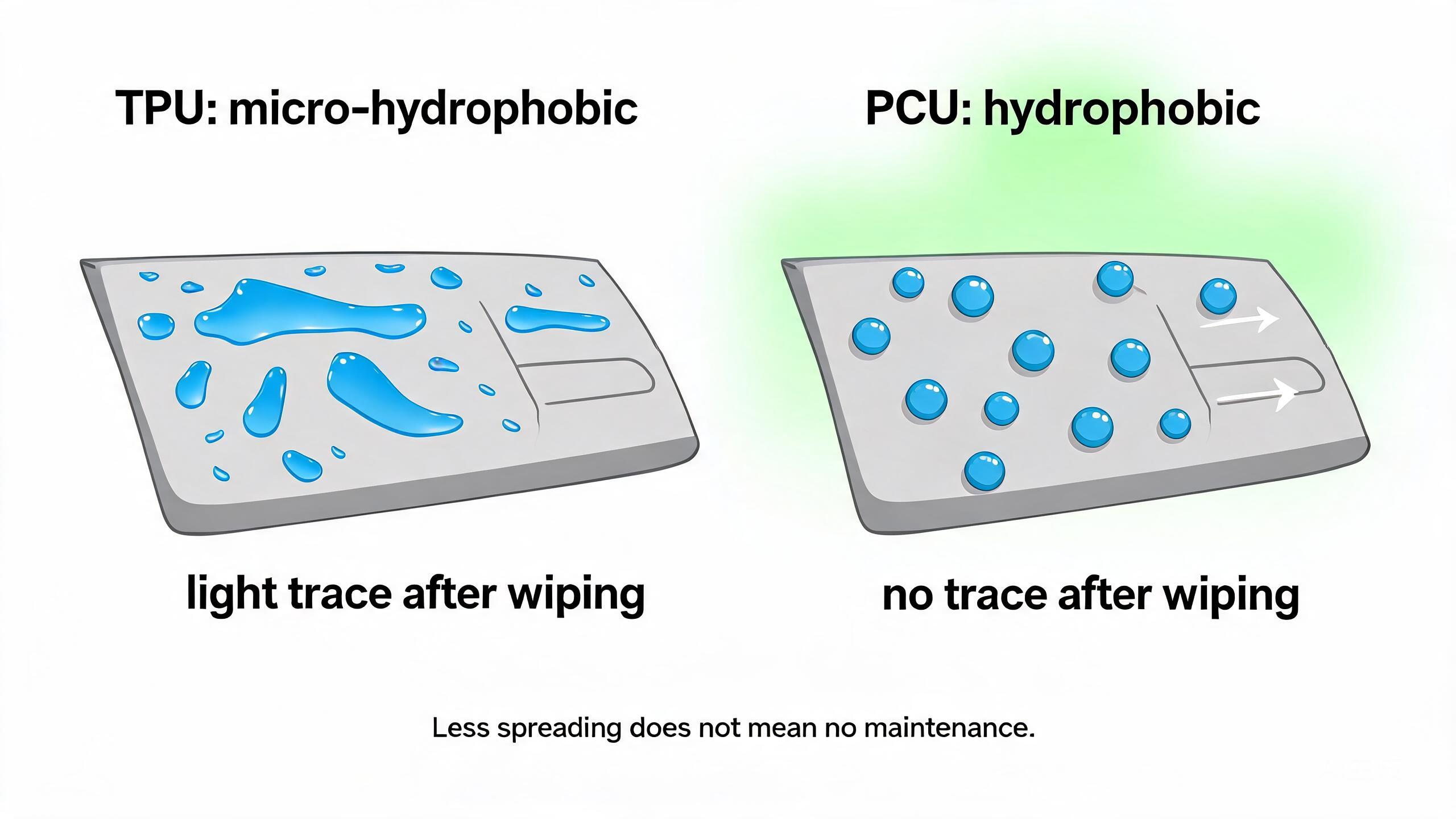
| Surface water behavior | Micro-hydrophobic | Hydrophobic | PCU beads water more effectively. Fewer water marks after rain or washing. |
| Marker penetration test | Light trace | No trace | PCU resists oil-based dirt better. Stains wipe clean with no visible trace. |
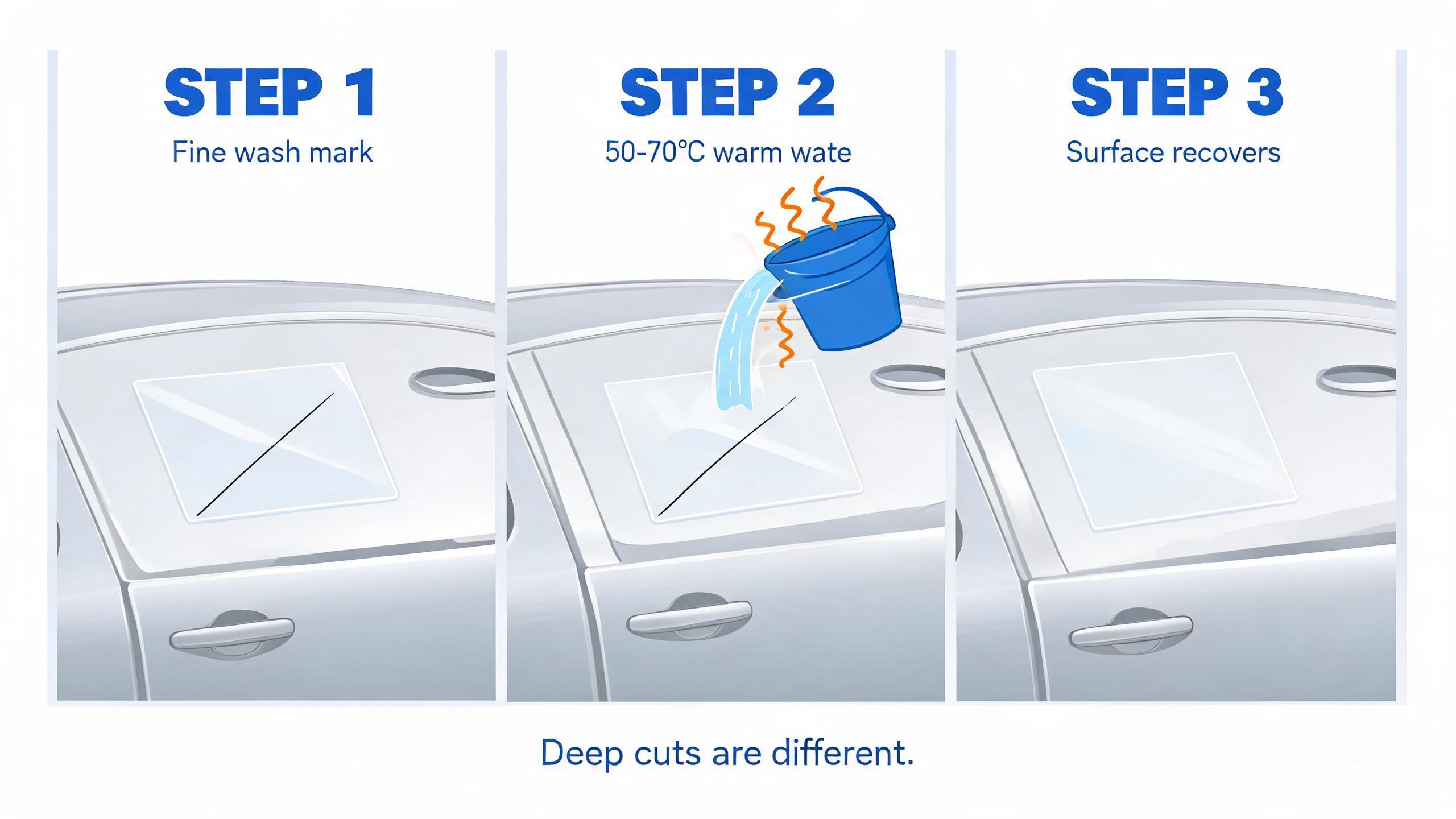
| Heat repair | 100% | 100% | Both recover from light wash marks with warm water. Deep cuts require replacement. |
| Adhesive peel (20 min) | 1,519 gf/in | 1,543 gf/in | PCU has higher early grip. Film stays positioned during installation. |
| Adhesive peel (24 h) | 1,852 gf/in | 1,856 gf/in | Both settle with strong attachment. PCU marginally higher. |
| Tear strength | 82 kN/m | 83 kN/m | Edge nick less likely to continue tearing on PCU film. |
| Tensile strength | 35 MPa | 36 MPa | PCU has more resistance when pulled during fitting or daily stress. |
| PPF elongation | 4.5 | 4.55 | PCU sample marginally higher. Confirm unit in TDS for engineering use. |
| 100% modulus | 9.173 MPa | 9.097 MPa | TPU slightly firmer at this point. A useful handling difference for installers. |
| Warranty | 5 سنوات | 5 سنوات | Both are premium products with the same stated warranty period. |
Data source: finished-film laboratory reports dated 2026-08-26. “Higher” is not automatically “better” for every parameter – lower haze, lower thickness and lower modulus can each be desirable in the right context.
What Gloss and Haze Feel Like on a Real Car
Gloss is the crisp reflection you see on a freshly detailed hood. The PCU sample measured 98.6 compared with 96.3 for the TPU sample. That extra 2.3 points gives the PCU film a noticeably brighter, more “wet paint” look when the panel, coating and lighting are clean.
Haze is the soft veil that can reduce visual sharpness. The TPU sample measured 3.18, while the PCU sample measured 4.3. That gives the TPU sample a small advantage in this optical test. In real use, installation cleanliness, paint condition, and lighting are just as noticeable as a small laboratory difference.
Why Hydrophobic Behavior Matters for Everyday Driving
The TPU report describes the surface as micro-hydrophobic. The PCU report describes it as hydrophobic and records no visible trace in the marker-and-alcohol cleaning test, compared with a light trace on the TPU sample.
For a driver, this means: rainwater forms rounder beads on the PCU surface, road film is less likely to spread into a dirty-looking patch, and washing takes less effort. It does not mean the surface is self-cleaning or immune to hard-water spots. Regular washing and drying still matter.
Self-Healing: What 100% Heat Repair Really Means
Both reports record 100% heat repair under the stated procedure: brushing with a brass brush ten times or soaking in 50-70 degree C hot water for one minute. Fine surface marks relax and close when the coating receives enough heat.
This is useful after light washing marks, not a promise that every scratch disappears. A deep cut that reaches through the coating or film is a physical loss of material. Good washing technique, correct temperature and professional installation remain important.
Adhesion and Strength: The Quiet Part of the Product
Most drivers notice gloss and water first, but the adhesive and mechanical properties determine whether a film installs cleanly and stays stable. Both samples used a 26 um acrylic adhesive layer from the same suppliers.
The PCU sample was higher in 20-minute peel, 24-hour peel, tear strength and tensile strength. These are not dramatic gaps, but they add up to a more robust finished film. The TPU sample was marginally firmer at the 100% modulus point, which can affect how an installer feels the film during stretching – a useful handling difference for professionals.
Which Film Should a Buyer Choose?
Choose the premium TPU (GS series) when you want a strong, flexible, hydrophobic five-year product and the lowest measured haze matters to your customer. It is a practical premium option for installers and distributors who want a balanced finished film.
Choose the PCU (PCT series) when the customer prioritizes maximum gloss, stronger water beading, easier surface cleaning and a thinner finished construction. It is especially suitable for high-end vehicles, showroom presentation and buyers who want the most refined surface behavior.
In both cases, the final result depends on installation. A clean paint surface, correct temperature, controlled stretching, sealed edges and sensible washing habits protect the investment as much as the polymer choice.
Why SHIELD SPIRIT PCU Is the Flagship Product
SHIELD SPIRIT is a professional PCU PPF manufacturer. Its PCU range is the company’s flagship product family, developed for buyers who care about the complete finished-film experience rather than a material name alone.
The PCU line is sold in more than 30 countries, supporting distributors, detailing studios and vehicle owners who need a consistent premium product with international application in mind. For a purchase decision, ask for the exact product code, current TDS, COA, test conditions, lot traceability, warranty wording and installer guidance.
See the SHIELD SPIRIT PCU PPF for the flagship range, or compare it with the premium TPU PPF. Buyers can also review the standard TPU PPF when budget is the main priority.
Buyer Checklist
- Ask whether the quoted number is for the finished film or only the base film.
- Request the test method, measured value, acceptance limit and test date.
- Confirm thickness by layer, including coating, adhesive and liner.
- Ask whether “self-healing” means fine heat-repairable marks or damage of every depth.
- Check whether hydrophobic performance is supported by contact-angle data and care instructions.
- Confirm warranty exclusions for installation, chemicals, hard-water marks and deep cuts.
- Match the film to the installer’s technique, climate and expected vehicle use.
الأسئلة الشائعة
Is PCU always better than TPU?
No. In this product-level comparison, PCU is stronger in several visible and mechanical areas, while TPU measured slightly lower haze, slightly higher UV blocking and slightly higher 100% modulus. The right choice depends on the customer’s priorities and the exact product specification.
Does a thinner film protect less?
Not automatically. Thickness is only one part of protection. Tear strength, tensile strength, coating behavior, adhesive stability, installation quality and warranty all matter. The PCU sample was 185 um and still recorded higher tear and tensile results.
Will hydrophobic PPF never get water spots?
No. Hydrophobic film helps water bead and leave the surface more readily, but minerals can remain when droplets dry. Wash and dry the vehicle properly, especially in hard-water areas.
Can both films repair scratches?
Both reports record 100% heat repair under the stated test procedure. This describes fine surface damage under suitable heat; it does not guarantee that deep cuts or missing material will disappear.
النقطة الأساسية
TPU and PCU are not just two marketing words. They are starting points for understanding a full PPF system. The laboratory data show a premium TPU film with strong clarity and balanced performance, while the higher-end PCU film adds a brighter gloss, more decisive hydrophobic behavior, cleaner marker-wipe results, higher strength readings and a slightly thinner finished construction.
For consumers, the plain-English conclusion is simple: premium TPU is a dependable choice; PCU is the flagship choice when surface refinement and top-tier appearance matter most. For distributors and installers: compare the complete finished-film report, not the resin label by itself.