









Does PCU PPF Never Yellow? The Honest Answer
Does PCU PPF Never Yellow? The Honest Answer
Here is the uncomfortable truth: "PCU never yellows" is not a complete material specification. It is a big marketing sentence. A clear paint protection film can be very resistant to yellowing. It can be engineered to stay clear for a long time. But no transparent polymer film can honestly promise to stay chemically and visually unchanged forever in every climate.
That does not mean every PCU film is the same, or that PCU is not a real improvement. It means buyers should ask a better question: What was tested, for how long, under what conditions, and what color-change limit was accepted? At SHIELD SPIRIT, we prefer to publish a defined performance window instead of selling a lifetime fantasy.
Plain-English answer: "Anti-yellowing" means a film is designed to slow yellowing. It does not mean the material has stopped aging forever.
Why "Never Yellow" Does Not Match Real-World Physics
A PPF is not a piece of glass. It is a multilayer polymer system: base film, topcoat, adhesive, stabilizers and liners during manufacture. Every layer has a job. Every layer sees heat, sunlight, water, oxygen, road grime and cleaning chemicals during real ownership.
Sunlight is one reason. UV energy can drive chemical changes in polyurethane materials. Heat can speed many aging reactions. Moisture can challenge polymer bonds and adhesive interfaces. Oxygen, ozone, bird droppings, tree sap, fuel residue and industrial fallout add more stress. None of this means a good film fails quickly. It means that "forever" is the wrong engineering word.
Think about sunglasses, clear phone cases and outdoor plastic signs. Even good products can change over enough time. Their makers may use better UV absorbers, better pigments or better resin chemistry, but they still publish a warranty, care instructions and test conditions. Clear automotive film deserves the same honest standard.
Material suppliers and published polyurethane research make the same basic distinction: aliphatic polyurethane chemistry can improve light and color stability, while polycarbonate-based polyurethane can improve hydrolysis resistance. Those are meaningful advantages. They are not a scientific exemption from all aging.
What should a buyer look for instead? A bounded claim. For example: a stated warranty period, a stated yellowing limit, a named test method, or a clear explanation of the intended environment. A promise without a time period is easy to say and hard to verify.
Even a Clear Film Needs Care and Eventually a Decision
Let us say a supplier could make a film that never showed visible yellowing. Would that mean you never need to care for it or replace it? No. Yellowing is only one part of PPF ownership.
- Topcoat condition: hydrophobicity, gloss, stain release and self-healing can change with use and cleaning.
- Surface contamination: iron fallout, hard-water spots, tree sap and road film can make a clear film look dull or stained even when the base film is still sound.
- Edges and adhesion: chips, repeated pressure washing at edges, poor installation and extreme heat can affect how a film sits on a panel.
- Impact history: PPF is sacrificial protection. After enough stone hits or abrasions, replacing a damaged section may be the sensible choice.
- Vehicle ownership plans: a driver may want a fresh finish before resale, after a body repair, or when the film has completed its intended service period.
This is where the word trade-off matters. Film engineering is not a game where every number can be pushed to the maximum at the same time. Optical clarity, softness for installation, self-healing response, surface hardness, stain resistance, adhesion, thickness, hydrolysis resistance and cost must work together. A formula can be excellent in one area and need balance in another.
For that reason, an honest PPF supplier should not use one headline claim to hide the rest of the construction. Ask about the whole film, not just one word on a sales poster.
A simple care rule: wash with pH-neutral products, remove bird droppings and tree sap early, avoid blasting film edges with a pressure washer, and ask an installer to inspect any lifted edge or deep impact. Good maintenance does not make a film immortal. It helps the film do its job for the period it was designed to serve.
Three SHIELD SPIRIT PPF Tiers With Published Limits
SHIELD SPIRIT offers three clear positions rather than one vague lifetime promise. The right choice depends on climate, vehicle value, customer expectation and budget.
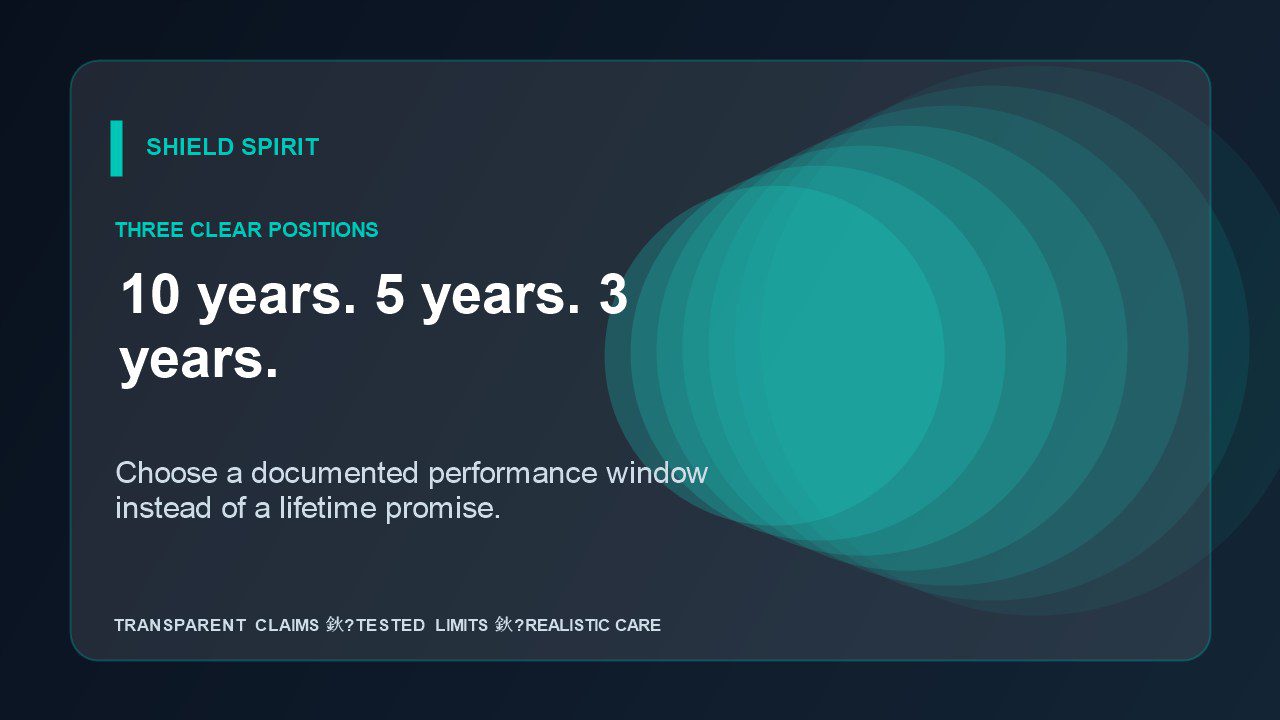
| Tier | Material and positioning | Published warranty | Published yellowing limit |
|---|---|---|---|
| Ultra-premium | PCU PPF PCT series | 10 years | PCT-75: max. 8% in 5 years; PCT-85: max. 6%; PCT-95: max. 5%; PCT-120: max. 3% |
| Premium | Hydrophobic TPU PPF GS series | 5 lat | Max. 10% in 5 years |
| Standard | Economical TPU PPF MH series | 3 years | Max. 10% in 3 years |
The PCU PCT range is our ultra-premium option for buyers who want the longest stated warranty and tighter published yellowing limits. The published limit varies by thickness and model, which is exactly how an honest specification should work: it identifies the product instead of making one loose promise for everything.
The GS series is a premium hydrophobic TPU option with a five-year warranty and a published maximum yellowing limit of 10% in five years. The MH series is the practical standard tier with a three-year warranty and a published maximum yellowing limit of 10% in three years. Neither is presented as a lifetime product, because the service window is part of the product definition.
Our position: a ten-year warranty is not a claim that a film is unchanged forever. It is a documented commitment for a defined product and intended service period.
How to Compare PPF Claims Like a Smart Buyer
When someone tells you a PCU film "will never yellow," do not argue about the slogan. Ask five practical questions:
- What exact product model is being discussed?
- What test or exposure condition supports the claim?
- What is the allowed color-change or yellowing limit?
- What is the written warranty period?
- What happens to the topcoat, adhesive and edges during that period?
If the answer is only "trust us," keep asking. If the answer includes a product page, a warranty and a measurable limit, you have something useful to compare.
For private-label buyers, the same rule applies at a larger scale. A dependable OEM PPF manufacturing process should control more than the base resin. It should manage raw materials, coating, adhesive behavior, in-process inspection, finished-product checks and traceable product information.
PCU PPF Yellowing Questions, Answered Simply
Is PCU PPF better than ordinary TPU for yellowing resistance?
PCU-based construction can offer meaningful durability and hydrolysis-resistance benefits. The correct comparison is still product-to-product, with a stated test window and published limit, not a material name alone.
Does anti-yellowing mean a film will never turn yellow?
No. It means the film is designed to resist or slow yellowing under stated conditions. It is not a promise of permanent zero change in every climate.
Why can a clear PPF look yellow even if the base film is good?
Surface staining, topcoat wear, adhesive changes, heat, UV exposure, contamination and poor maintenance can all affect appearance. Yellowing is not the only condition that matters.
Which SHIELD SPIRIT tier should I choose?
Choose PCT PCU for the longest stated warranty and tighter published yellowing limits, GS hydrophobic TPU for premium five-year positioning, or MH standard TPU for an economical three-year option. Match the tier to the market and the customer promise you can support.
The Honest Promise Is Better Than the Biggest Promise
At SHIELD SPIRIT, we do not need to tell consumers a film lasts forever. We would rather show the product tier, the warranty period and the published yellowing limit, then let buyers compare the facts.
That is not weaker marketing. It is stronger trust. A good PPF should protect paint, preserve appearance and give the owner a clear, realistic service plan. It should not ask the owner to believe that physics has been cancelled.
Do you prefer a lifetime slogan, or a film with a clear product model, written warranty and measurable performance limit? Contact our team to discuss the PPF tier that fits your market.
Five questions for the PPF market
- Should "never yellow" be accepted without a test period? Why or why not?
- Would you rather sell a lifetime slogan or a documented warranty?
- Which matters most to your customers: clarity, self-healing, stain resistance or warranty length?
- Should PPF brands publish a yellowing limit for every model?
- Is a realistic replacement plan more trustworthy than a promise of no replacement ever?