










دليل اختبار جودة أفلام حماية الطلاء (PPF): 7 معايير لتقييم فيلم حماية الطلاء
The PPF brand name on the box tells you almost nothing about what you’re actually buying. A dealer can print “premium PPF” on any package, but the inspection report — specifically, seven measurable parameters — separates a genuine premium film from a counterfeit marketed at the same price. This guide decodes real factory quality-control data so you can challenge dealers with the same standards OEM factories use to approve or reject each production batch.
Why Factories Test Every Batch (Even in a Cleanroom)
Our facility operates cleanroom production lines where 60+ technicians work under strict contamination protocols: dedicated garments, multi-stage sanitization, and scheduled equipment maintenance. Yet we still sample-test every finished order. Because PPF is not a single-material product — it’s a precision-engineered multilayer system vulnerable to variation at every production stage.
The Four Critical Layers
- Substrate (base polymer film): Determines tensile strength, elongation, and long-term durability — the foundation of the whole system.
- Self-healing topcoat: Provides scratch-repair capability under heat.
- Adhesive layer: Controls initial tack, 24-hour bond strength, and residue risk.
- Release liner (PET): Protects the film during shipping and storage.
A substrate batch with 15% lower elongation can tear during installation on curved surfaces. An adhesive lot with weak 24-hour cure strength will edge-lift within six months. These failures only surface through systematic parameter testing — visual inspection catches almost none of them.
The 7 Core Parameters: What the Numbers Mean
The data below comes from a real batch inspection report (Model: TPU-Matte Black-2, Batch: A0220260417-4, tested 48–72 hours after production). For each parameter we explain the technical meaning, the industry benchmark, and the specific fraud tactic dealers use to misrepresent low-grade film.
1. Substrate Thickness
Our test result: 150 μm (standard range ±3 μm, i.e. 147–153 μm acceptable) · Method: ASTM D374 / GB/T 6672.
Substrate thickness directly governs impact resistance and service life. Thicker film absorbs stone-chip energy better and resists puncture during installation. But thickness alone doesn’t define quality — a 200 μm film made from recycled resin performs worse than a 150 μm virgin-polymer film.
Industry Grades
- Premium: 150–200 μm (6–8 mil)
- Standard: 125–150 μm (5–6 mil)
- Economy: 100–125 μm (4–5 mil)
Real-World Impact
- Too thick (>200 μm): edges struggle to conform to tight curves and may lift.
- Too thin (<120 μm): tears easily while stretching, minimal stone-chip protection.
Common Fraud: “Thickness Inflation”
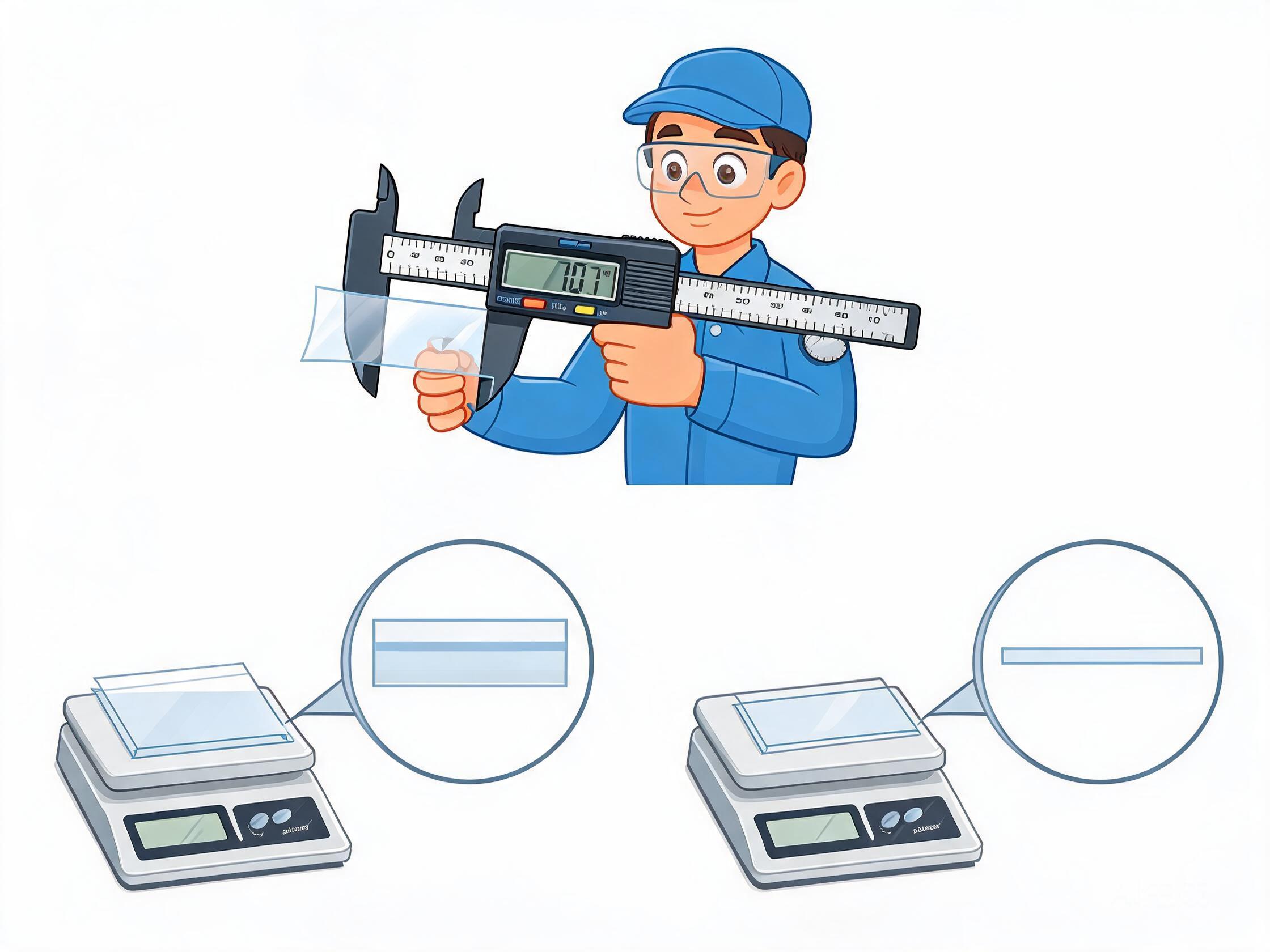
The scam: the dealer verbally promises “8 mil premium thickness” but delivers a 5 mil (125 μm) film.
How to expose it: demand the batch inspection report; use a $15–30 digital micrometer (150 μm = 0.15 mm); compare weight on identical sample dimensions.
Challenge script: “You said this is 8 mil (200 μm). I measured 0.12 mm (120 μm). That’s 5 mil. Can you explain the 40% discrepancy, or provide a certified measurement?”
2. Elongation at Break
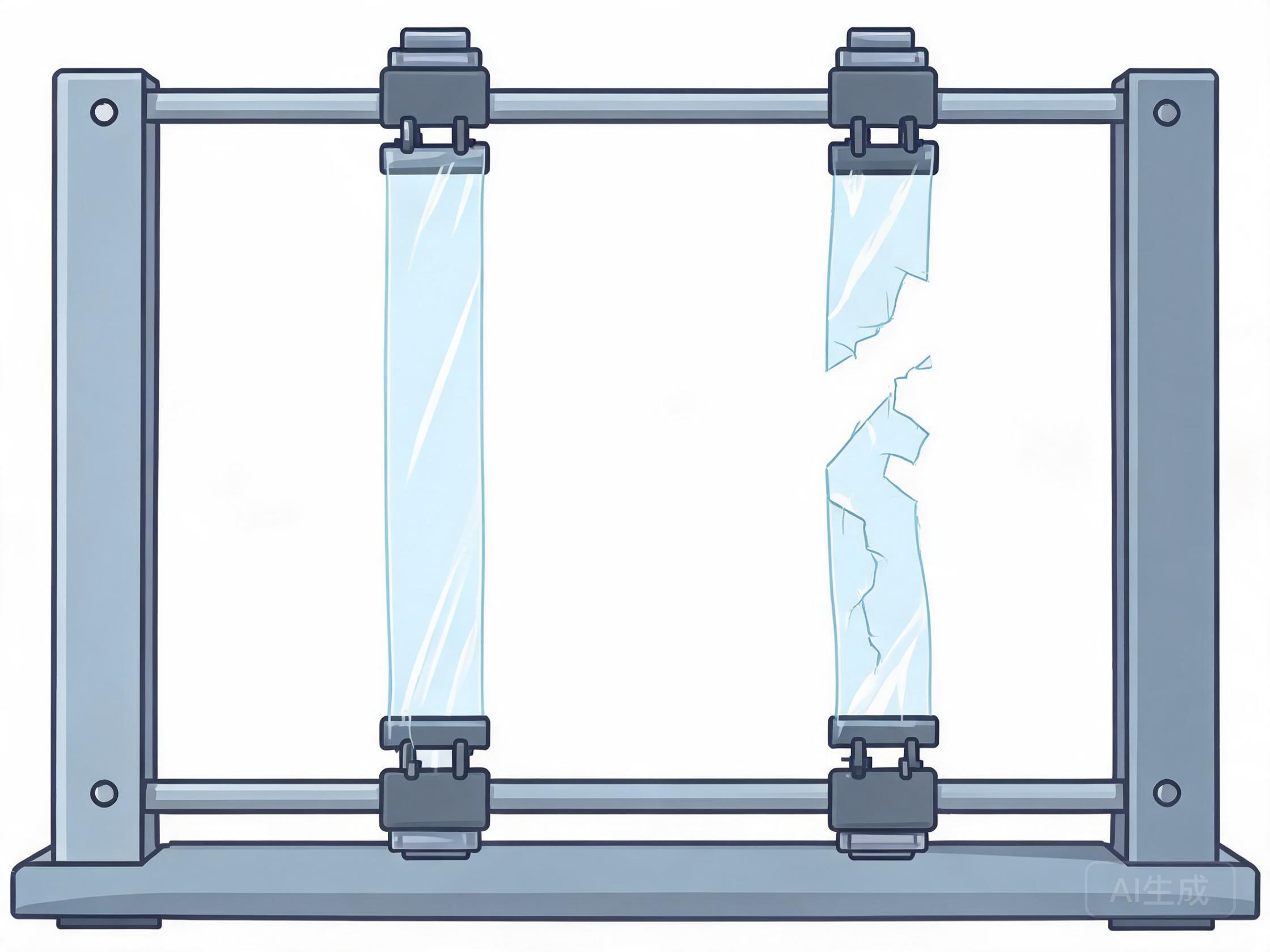
Our test results: transverse 380%, longitudinal 384% · Standard minimum: ≥230% both directions · Method: ASTM D638 / GB/T 1040-2006.
Elongation at break measures how far the film stretches before tearing. A 380% result means a 10 cm sample stretches to 48 cm before failure. High elongation lets the film conform to complex curves (mirrors, bumpers, fenders) without tearing, and resists stress marks as the vehicle flexes over time.
Industry Grades
- Excellent (virgin aliphatic TPU or PCU): ≥350%
- Acceptable (standard cast-grade TPU): 230–350%
- Substandard (recycled resin): <230%
Real-World Impact
- Too high (>500%): material may sag or wrinkle on vertical panels in heat.
- Too low (<200%): tears at every contour; installer needs 2–3 replacement pieces per panel.
Common Fraud: “Recycled TPU Substitution”
The scam: recycled-resin TPU (150–200% elongation) sold as virgin polymer (350%+). Recycling degrades molecular chains, cutting both elongation and tensile strength.
How to expose it: check elongation on the report (<250% is a red flag); do a manual stretch test (premium film stretches to 30+ cm); inspect the tear edge (virgin tears clean and glossy, recycled tears rough and chalky).
Challenge script: “Your report shows 210% elongation. Virgin TPU is 350%+. This is typical of recycled resin. Can you provide an MSDS or supplier certification proving virgin polymer content?”
3. Tensile Strength at Break
Our test results: transverse 38 MPa, longitudinal 39 MPa · Standard minimum: ≥15 MPa · Method: ASTM D638 / GB/T 1040.
Tensile strength is the maximum pulling force per unit area the film withstands before tearing. 38 MPa means each square millimeter of cross-section carries 38 newtons. 35+ MPa resists highway stone chips and high-pressure washes; 15–25 MPa is adequate for normal driving; <15 MPa develops pinholes within 6–12 months.
Industry Grades
- Premium (PCU / aliphatic TPU): ≥35 MPa
- Standard (aromatic TPU): 25–35 MPa
- Budget: 15–25 MPa
- Substandard: <15 MPa
Common fraud — “PCU mislabeling”: standard aromatic TPU (18–22 MPa) marketed as premium PCU (35+ MPa). Verify tensile strength, request supplier documentation, and cross-check with elongation (PCU pairs high tensile with high elongation; if one is high and the other low, the claim is suspect).
Challenge script: “You advertised PCU, but the report shows 18 MPa. PCU requires ≥35 MPa. Please provide substrate supplier certification or correct the material designation.”
4. Adhesion Force (Peel Strength)
Our test results: initial 1,687 g · 20-minute 1,420 g · 24-hour 1,445 g · Standards: initial ≥1,600 g, 24-hour ≥2,000 g · Method: GB/T 2792 / ASTM D903.
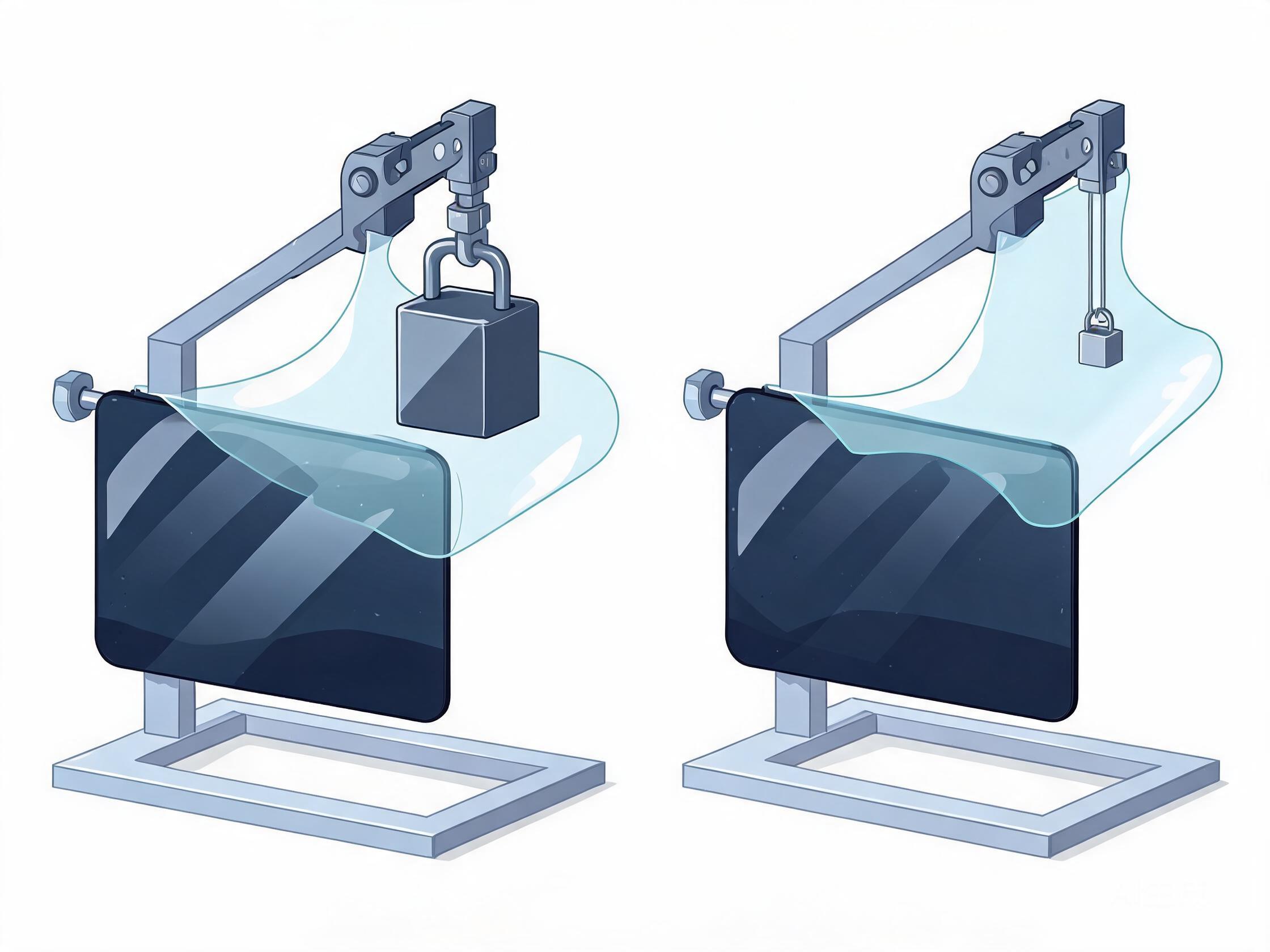
Adhesion force is the pulling force (in grams) needed to peel a 25 mm strip at a 180° angle. The adhesive cures over time, so we test at intervals: initial tack (strong enough to hold, not so strong you can’t reposition) and 24-hour cure (final bond strength driving long-term edge durability).
Why our 24-hour result is slightly below standard: 1,445 g against a 2,000 g benchmark signals the cure process needs monitoring — a longer climate-controlled hold before delivery. This is exactly why we batch-test: catching borderline results before shipment prevents edge-lifting complaints six months later.
Real-World Impact
- 24-hour adhesion <1,500 g: edges lift within 6–12 months on curved surfaces or in hot climates.
- Initial adhesion >2,000 g: film cannot be repositioned; one wrong placement ruins the piece.
Common Fraud: “Domestic Adhesive Substitution”
The scam: claiming imported acrylic adhesive (Ashland, Henkel, 3M) while using low-cost domestic adhesive that never reaches 2,000 g cure strength. Some fraudsters compensate with thicker adhesive layers (>35 μm), which raises haze and yellowing risk.
How to expose it: the report must name a recognized adhesive supplier; premium imported adhesives hit 2,200–2,500 g; adhesive layer should be 25–30 μm.
Challenge script: “You said Ashland. The report lists ‘domestic acrylic’ at 1,600 g. Ashland cures to 2,200+ g. Can you provide the supplier invoice or certificate?”
5. Self-Healing Layer Thickness & Performance
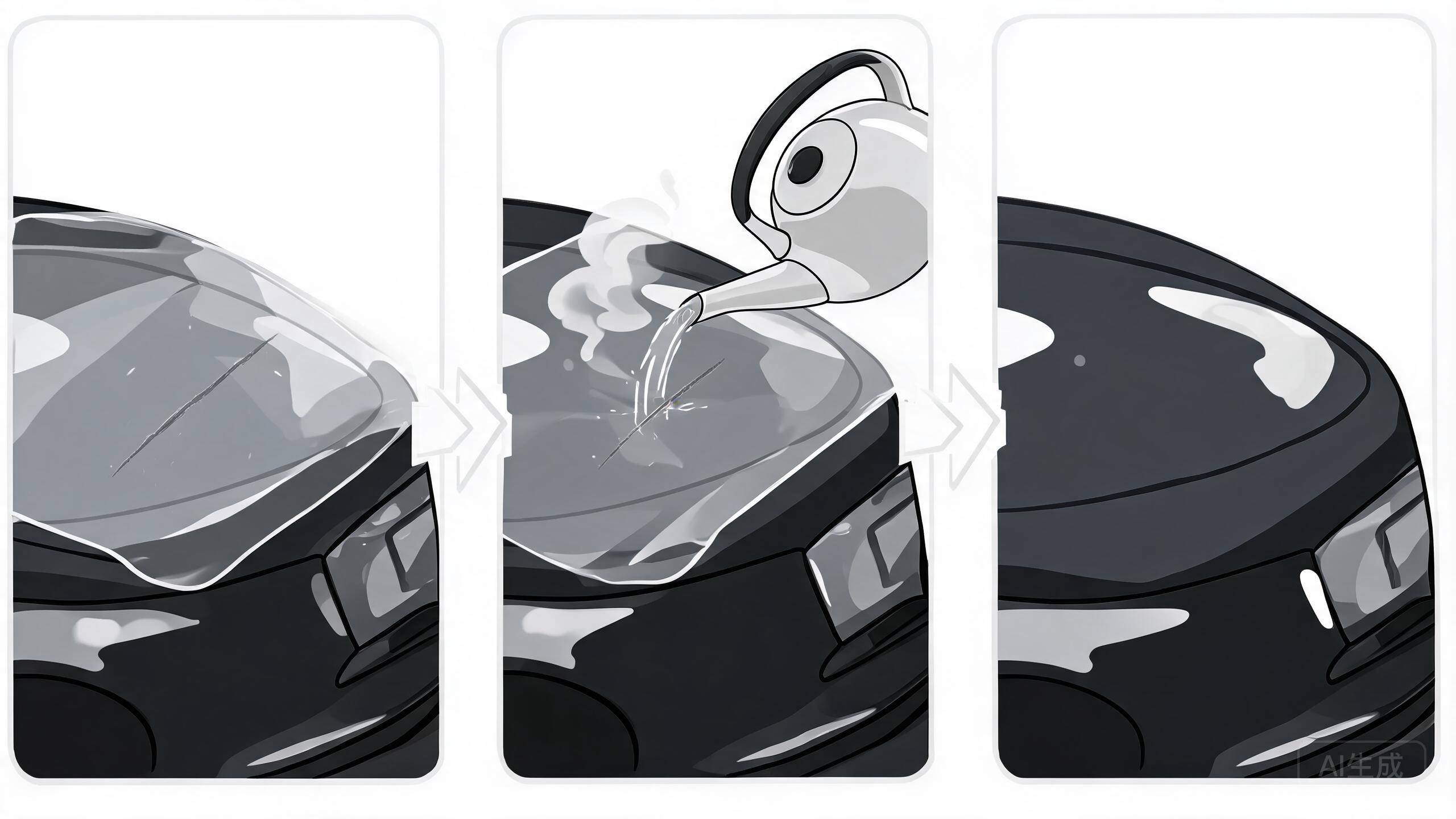
Our test results: healing layer 7 μm · complete surface recovery, no delamination · Standard: ≥6 μm, visible scratch recovery within 72 hours at 40–50°C · Method: steel-wool scratch (500 g) then 40°C hot-water immersion for 10 minutes.
The self-healing topcoat flows under heat to fill surface scratches. Test sequence: (1) a steel-wool pad creates standardized scratches; (2) the sample is immersed in 40°C water for 10 minutes or exposed to sunlight; (3) after 48–72 hours the scratches should be invisible under normal lighting.
Industry Grades
- Excellent: ≥8 μm, 48-hour complete recovery
- Standard: 6–8 μm, 72-hour recovery
- Basic: 4–6 μm, 96-hour partial recovery
- No healing: <4 μm or absent topcoat
Common fraud — “false self-healing”: selling standard TPU without a healing layer as “self-healing PPF,” or calling heat-gun repair “self-healing.” All thermoplastic film can be melted with a heat gun — that’s not engineered self-healing.
How to expose it: the report must list healing-layer thickness and a healing-performance test; do an on-site scratch + hot-water test (genuine film shows improvement in 10 minutes); if the dealer says “you need a heat gun,” that’s manual repair, not self-healing.
Challenge script: “I don’t see healing-layer thickness or a healing performance test in your report. Real self-healing film has a topcoat (≥6 μm) that repairs passively under sunlight or hot water — not with a heat gun.”
6. Water Contact Angle (Hydrophobicity)
Our test result: 102° · Standard: ≥100° for hydrophobic coating · Method: ASTM D7334 / GB/T 30693.
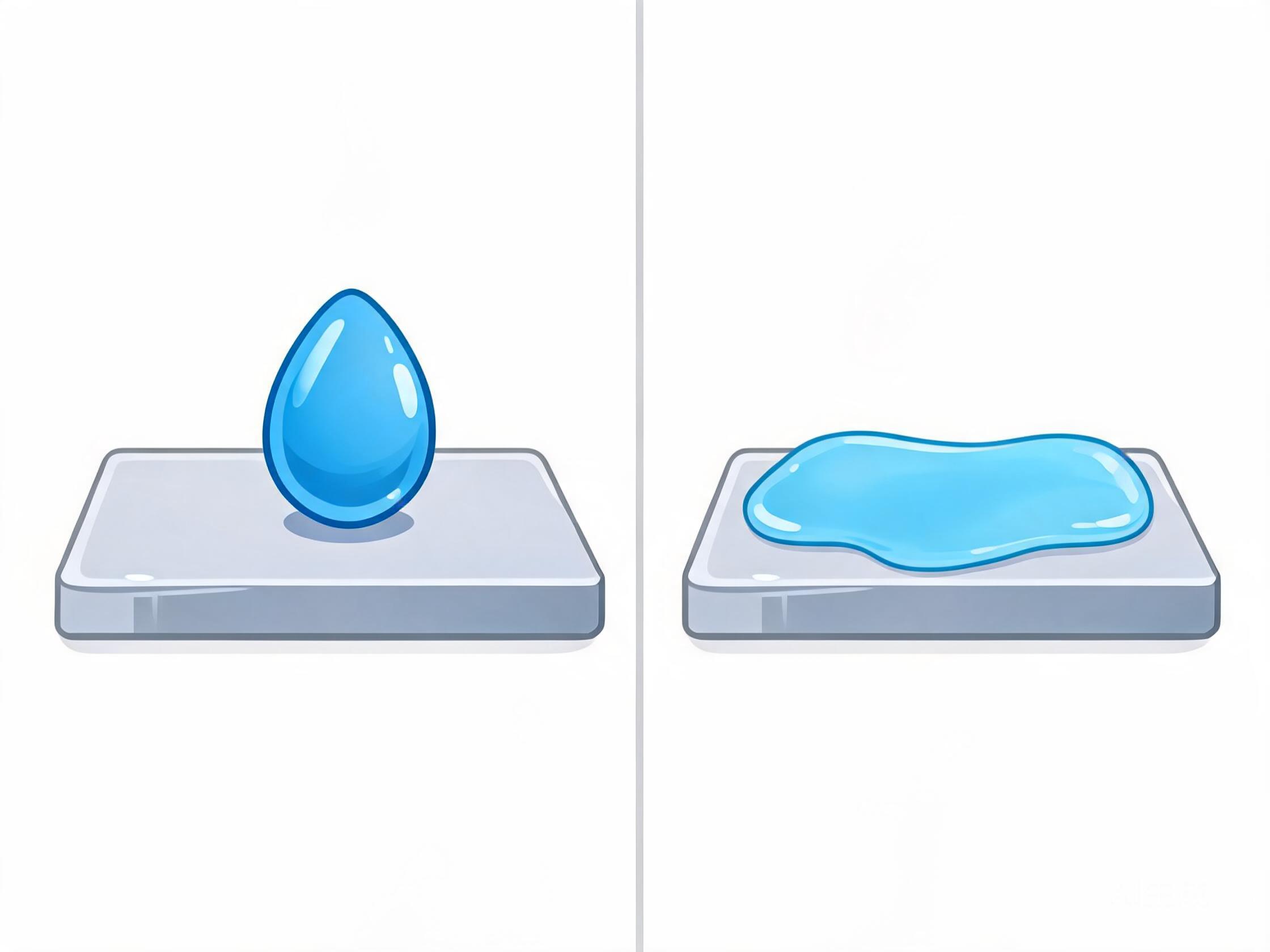
Water contact angle is the angle between a droplet’s edge and the film surface: >90° hydrophobic (water beads), >100° strongly hydrophobic (water rolls off), <90° hydrophilic (water spreads flat). At 102°, rainwater beads and rolls off at low speeds, washing is easier, and water spots dry faster.
Hydrophilic vs. Hydrophobic Trade-Off
Hydrophilic coatings (<90°) are a legitimate choice — water spreads into a uniform sheet, which some users prefer for rinsing. The fraud occurs when a dealer sells hydrophilic film while promising hydrophobic self-cleaning performance.
How to expose it: check “water contact angle” in the report (hydrophobic must be ≥100°); do a simple water-drop test (bead and roll = hydrophobic, spread flat = hydrophilic); ask for a named topcoat supplier.
Challenge script: “You promised hydrophobic coating, but the water spreads flat. That’s hydrophilic. Your report should show ≥100°. Can you provide the actual measurement?”
7. Gloss Level
Our test result: 3.8 GU · Standard: glossy ≥88 GU, matte ≤10 GU · Method: ASTM D523 / GB/T 9754.
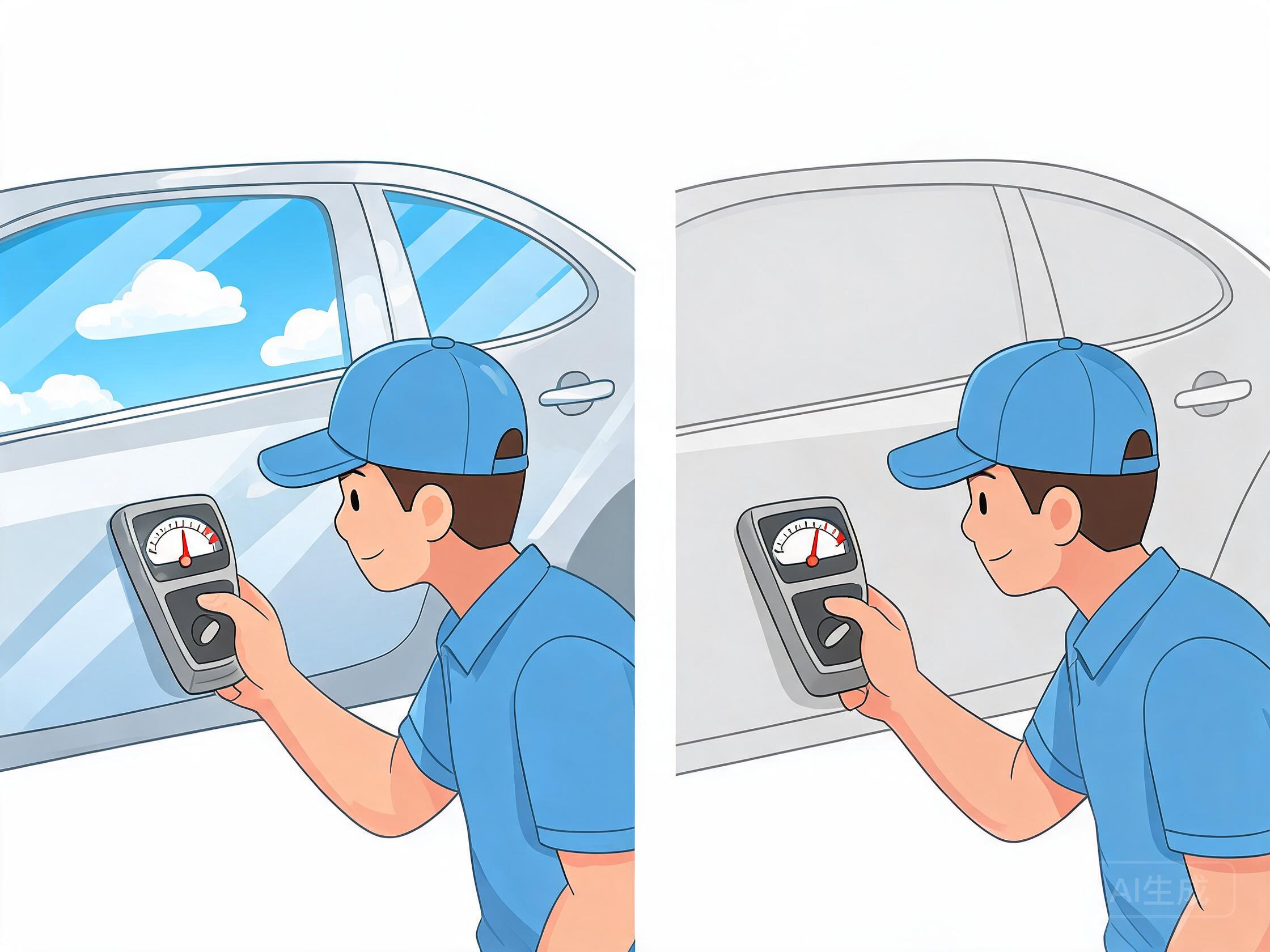
Gloss measures how much light reflects at a 60° angle. At 3.8 GU this is clearly a matte finish. Gloss is purely aesthetic — it doesn’t affect durability or protection — but misrepresentation is common: charging matte pricing while delivering glossy film, or vice versa (matte costs more due to its specialized topcoat).
How to expose it: verify the gloss level in the report; glossy film reflects light sharply while matte diffuses it into a soft glow; photograph the film under light (glossy shows a bright hot spot, matte shows even illumination).
Challenge script: “You said glossy, but the report shows 4.2 GU — that’s matte spec. Glossy must be ≥88 GU. Did you mix up the product code, or is this intentional substitution?”
Additional Key Parameters (Quick Reference)
| المعلمة | Our Result | Standard | Fraud Red Flag |
|---|---|---|---|
| Adhesive layer thickness | 26 μm | 25–30 μm | >35 μm suggests weak adhesive compensated by excess volume |
| Light transmittance | 88% | ≥85% | <80% makes paint look dull or hazy |
| Total thickness | 208 μm | ±3 μm | Verify sum matches individual layer measurements |
| Stain resistance | Pass | No color change | Failure indicates poor topcoat cure |
| Adhesive odor | No harsh smell | No pungent/solvent odor | Strong smell = uncured or low-grade adhesive |
| Ball-crumple yellowing | No yellowing | No yellowing | Yellowing = poor oxidation resistance |
Consumer Self-Protection Checklist
Three Mandatory Documents
- Batch inspection report — must list all seven parameters, carry a testing seal, and match the batch number on the packaging.
- Material supplier certificates — substrate (Lubrizol, BASF, Covestro, Wanhua), adhesive (Ashland, Henkel, 3M), topcoat (named suppliers).
- Warranty card — premium 5–10 years, standard 3–5 years; serialized with manufacturer contact.
Five On-Site Tests
- السماكة: digital caliper — 150 μm = 0.15 mm.
- Elongation: a 10 cm strip should stretch to 30+ cm without tearing.
- Self-healing: key scratch + 50°C water; observe 10 minutes.
- Hydrophobicity: water droplet should bead and roll.
- Gloss: compare reflection — glossy shows a sharp mirror image, matte diffuses light.
How to Challenge Six Common Dealer Excuses
| Dealer Excuse | Your Response |
|---|---|
| “Test reports are proprietary.” | “It’s the only proof of quality. I’ll sign an NDA. If you can’t show it, how can I trust the product meets your claims?” |
| “This is imported film; foreign standards differ.” | “Then provide the certificate of origin, customs declaration, and foreign lab report. ASTM and ISO are international — there’s no ‘different standard’ for these parameters.” |
| “These parameters are too technical.” | “If the product is good, transparency should support your claims. I can have an expert interpret the report.” |
| “Our film is proven by use, not testing.” | “Yellowing and edge-lift take 1–2 years — after warranty. Without baseline data there’s no way to assess quality.” |
| “The report is at headquarters.” | “Then email me the digital copy. If you don’t have your own product’s quality documentation, how did you verify it before stocking?” |
| “We use the same material as [big brand].” | “Then why does your report show 200% while that brand publishes 380%? Provide your substrate purchase contract.” |
Summary: The Seven Numbers That Protect You
- Substrate thickness: ≥150 μm (6 mil)
- Elongation: ≥350%
- Tensile strength: ≥35 MPa (PCU / aliphatic TPU grade)
- 24-hour adhesion: ≥2,000 g
- Self-healing layer: ≥6 μm, recovery within 72 hours
- Water contact angle: ≥100° if advertised hydrophobic
- Gloss level: glossy ≥88 GU, matte ≤10 GU — must match the claimed finish
Remember: “No inspection report = not premium PPF. A dealer who won’t show the report = not a trustworthy dealer.”
Factory Transparency as Industry Standard
Our facility — Class 10,000 cleanrooms, 60+ trained technicians, and batch-by-batch sampling — openly shares this real inspection data for two reasons: customer confidence (you deserve to know exactly what you’re buying before spending $2,000–$5,000 on full-vehicle coverage) and industry accountability (transparency pressures competitors to meet verifiable standards).
This report (Batch A0220260417-4, tested 48–72 hours after production) shows both strengths — 380% elongation, 38 MPa tensile — and an area for monitoring (24-hour adhesion slightly below target). That’s honest quality control, not perfection theater.
If you’re choosing between film types for your install, compare genuine options like our next-gen PCU paint protection film and read the premium TPU paint protection film spec sheet against the benchmarks above.
If You Discover Fraud: Your Legal Options
- Negotiate a refund or replacement using this guide’s benchmarks.
- File a consumer complaint — 12315 in China, FTC in the USA, Trading Standards in the UK.
- Get third-party testing — SGS, Intertek, or Bureau Veritas (about $300–500, admissible in court).
- Pursue legal action — many jurisdictions award treble damages for proven fraud.
Case example: In 2023 a Shenzhen owner paid RMB 28,000 for “USA-imported PCU film.” After severe yellowing he demanded the report — 190% elongation, 18 MPa tensile, unmistakably recycled standard TPU, not PCU. Third-party testing confirmed the fraud, and the court awarded RMB 84,000 (original price plus treble damages).
Disclaimer
All test data in this guide comes from our facility’s actual production records and is provided for consumer education only. Standards may vary by brand, model, and region — always defer to the specific product’s certified inspection report. This guide does not target any particular brand or dealer; its sole purpose is industry transparency and consumer protection.