








TPU vs PCU Paint Protection Film: Why Conventional TPU Is Already Obsolete in 2026
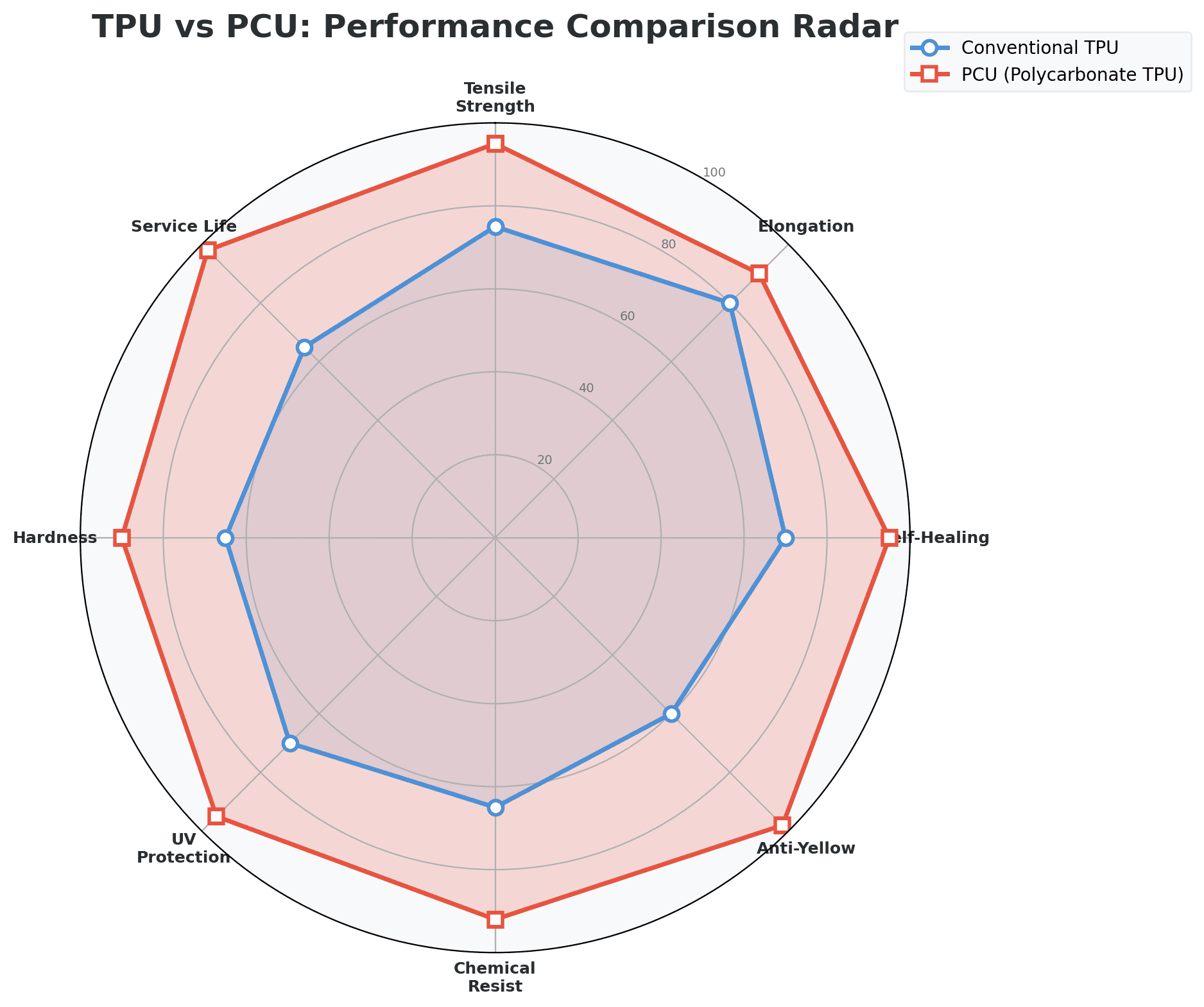
Hard data comparing TPU vs PCU PPF across 8 performance dimensions: tensile strength, self-healing speed, anti-yellowing, chemical resistance, and lifetime cost. Learn why PCU outperforms TPU by 30%+ and how SHIELD SPIRIT's factory-direct OEM/ODM delivers next-gen PPF.
Here’s an uncomfortable truth the PPF industry doesn’t want spoken aloud: most “premium TPU” paint protection films on the market today are already obsolete. They were designed for a world that existed five years ago, before polycarbonate-enhanced TPU rewrote the rules. If you’re still buying, selling, or installing conventional TPU PPF in 2026, you’re leaving 30% of the performance on the table. And your customers will notice.
The question isn’t whether TPU works. It does. The question is whether you’re satisfied with “good enough” when “dramatically better” is sitting on the same shelf, at a price point that makes the upgrade a no-brainer for any serious buyer. This article breaks down the hard data across eight critical performance dimensions comparing conventional TPU against next-generation PCU (Polycarbonate TPU).
What Makes PCU Different: It’s Not “Just Another TPU”
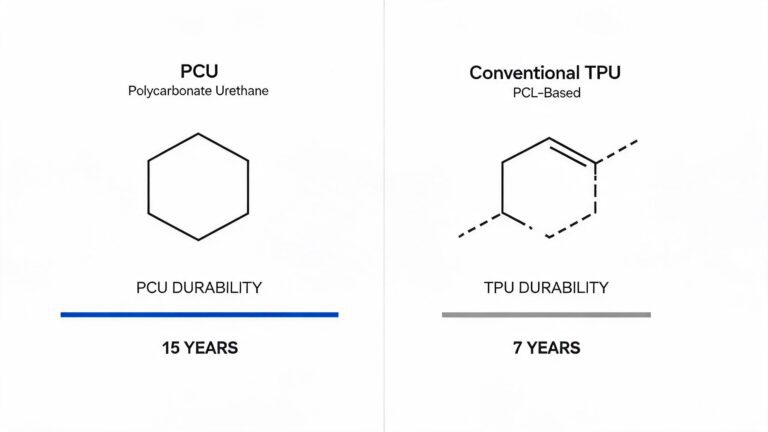
Let’s kill the biggest misconception first. PCU is not a marketing rebrand of TPU. It is a fundamentally different material structure. Conventional TPU (thermoplastic polyurethane) is built from alternating soft and hard segments — polyol chains held together by urethane linkages. It works, which is why it has been the industry standard for over a decade. But it has a ceiling.
PCU embeds polycarbonate molecular segments directly into the TPU backbone. The result is a hybrid polymer that inherits TPU’s elasticity while gaining the hardness, chemical resistance, and UV stability of polycarbonate. Think of it this way: if conventional TPU is a marathon runner (elastic, endurant, but not particularly strong against sharp impacts), PCU is a decathlete — it does everything at an elite level. At SHIELD SPIRIT, our 70,000 sqm factory has been manufacturing PCU-based PPF for global OEM/ODM partners since the technology became commercially viable, and the performance gap has only widened with each generation.
Physical Properties: The Numbers Don’t Lie
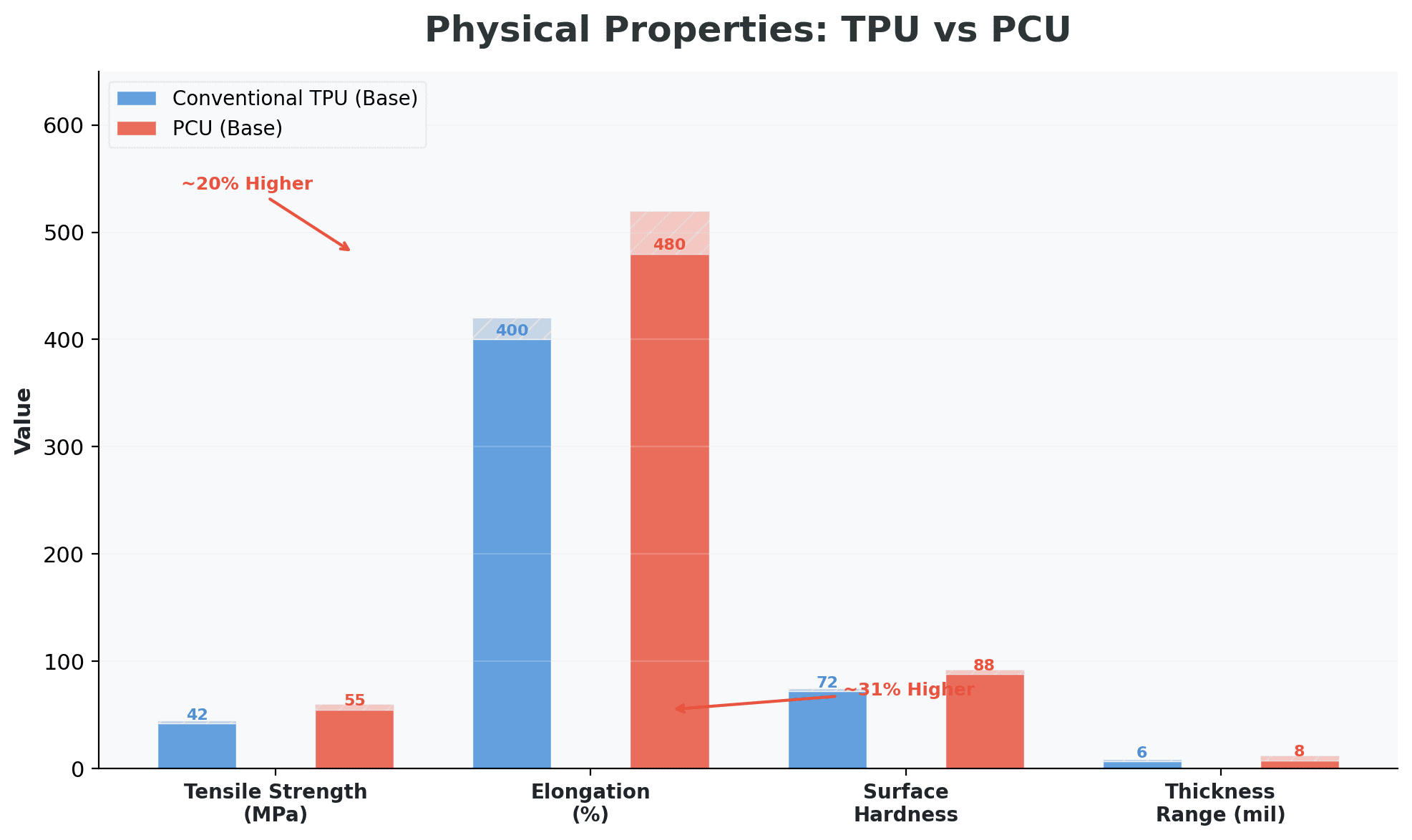
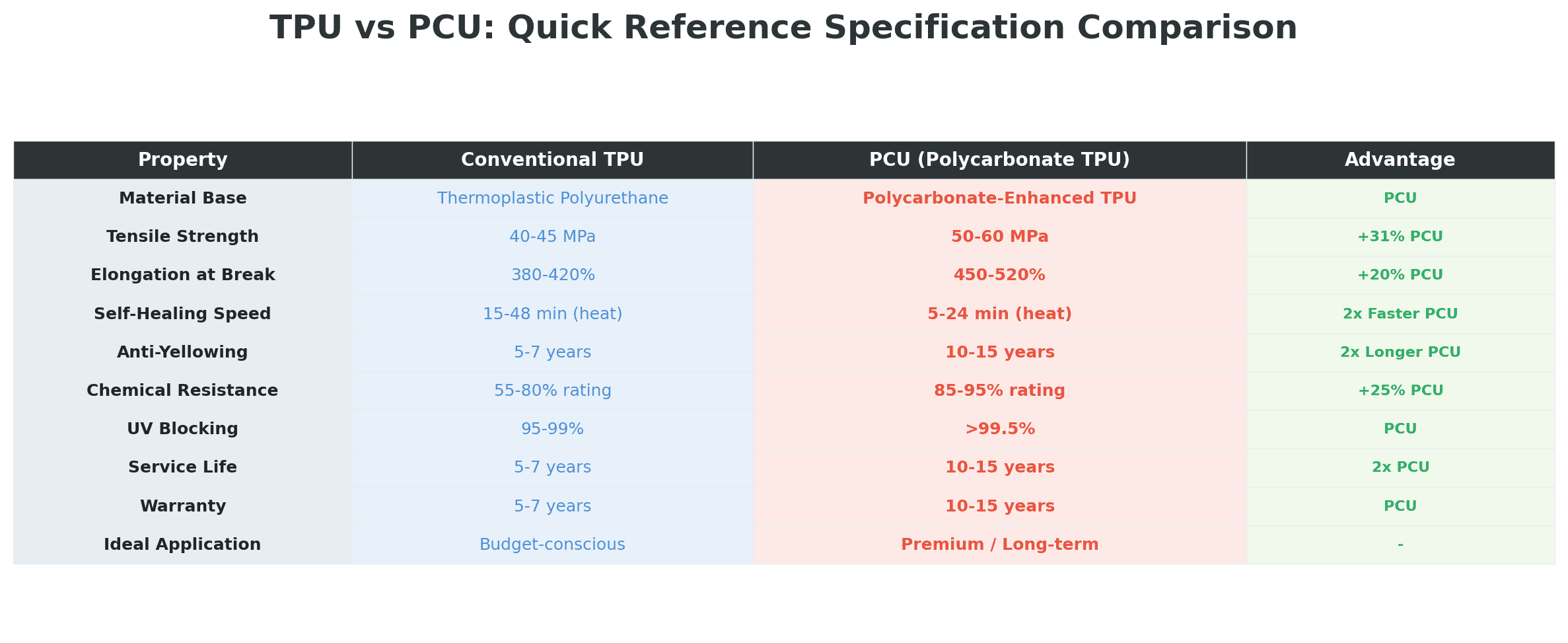
Let’s get specific. When we test conventional TPU and PCU films side by side in our laboratory, the physical property differences are impossible to ignore. PCU films consistently deliver tensile strength in the 50-60 MPa range — roughly 31% higher than the 40-45 MPa typical of premium aliphatic TPU. Elongation at break averages 480-520% for PCU versus 380-420% for TPU. Surface hardness measured by Shore durometer is approximately 22% higher on PCU formulations.
Why does any of this matter to a car owner? Because tensile strength determines how much road debris impact the film can absorb before failing. Elongation determines how well the film conforms to complex body panels during installation — and how well it recovers from deep scratches. Hardness determines scratch resistance in daily use. In every single one of these metrics, PCU outperforms conventional TPU by a margin that is both statistically significant and practically meaningful.
Self-Healing: The Speed Gap Nobody Talks About
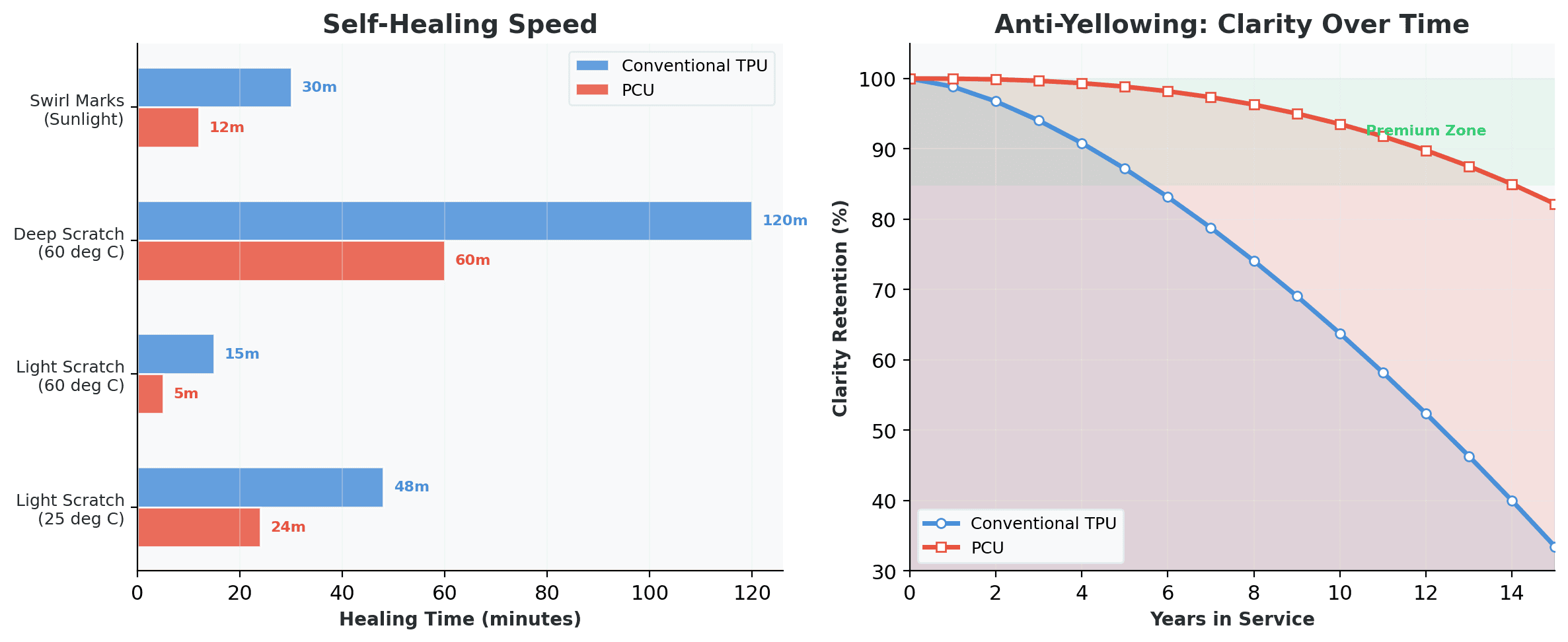
Every PPF manufacturer claims “self-healing.” Few discuss the speed of that healing — and speed is everything. Our lab tests show that PCU films heal light scratches approximately 2x faster than conventional TPU across all temperature ranges. At 60 degrees C (easily reached by direct sunlight or warm water), deep scratches resolve on PCU in roughly 5 minutes versus 15+ minutes on standard TPU.
The difference comes down to molecular mobility. Polycarbonate segments create a more ordered hard-segment domain structure in PCU, which means the polymer chains “remember” their original configuration more precisely and return to it more quickly when energy (heat) is applied. This isn’t marginal improvement — it’s the difference between a customer seeing a scratch disappear during a coffee break versus waiting until the next day.
Anti-Yellowing: The 15-Year Reality Check
Here’s where the industry’s dirty laundry starts showing. Aromatic TPU — still sold by budget manufacturers — begins yellowing within 12-18 months. Even premium aliphatic TPU shows measurable yellowing (delta YI greater than 2) after 5-7 years of UV exposure. PCU films, with their inherently UV-stable polycarbonate backbone, maintain delta YI below 1.5 for 10-15 years under the same conditions.
This isn’t speculation. Accelerated weathering tests (QUV ASTM G154, 3000+ hours) consistently place PCU clarity retention at 92-95% after the equivalent of a decade of outdoor exposure, versus 70-78% for aliphatic TPU. When SHIELD SPIRIT offers a 15-year warranty on our PCU products, it’s backed by actual aging data — not marketing optimism. If your current supplier won’t share their UV aging test reports, ask yourself why. For a deeper look at how we manufacture and test our films, our factory quality control process is fully transparent.
Chemical Resistance: The Forgotten Battlefield
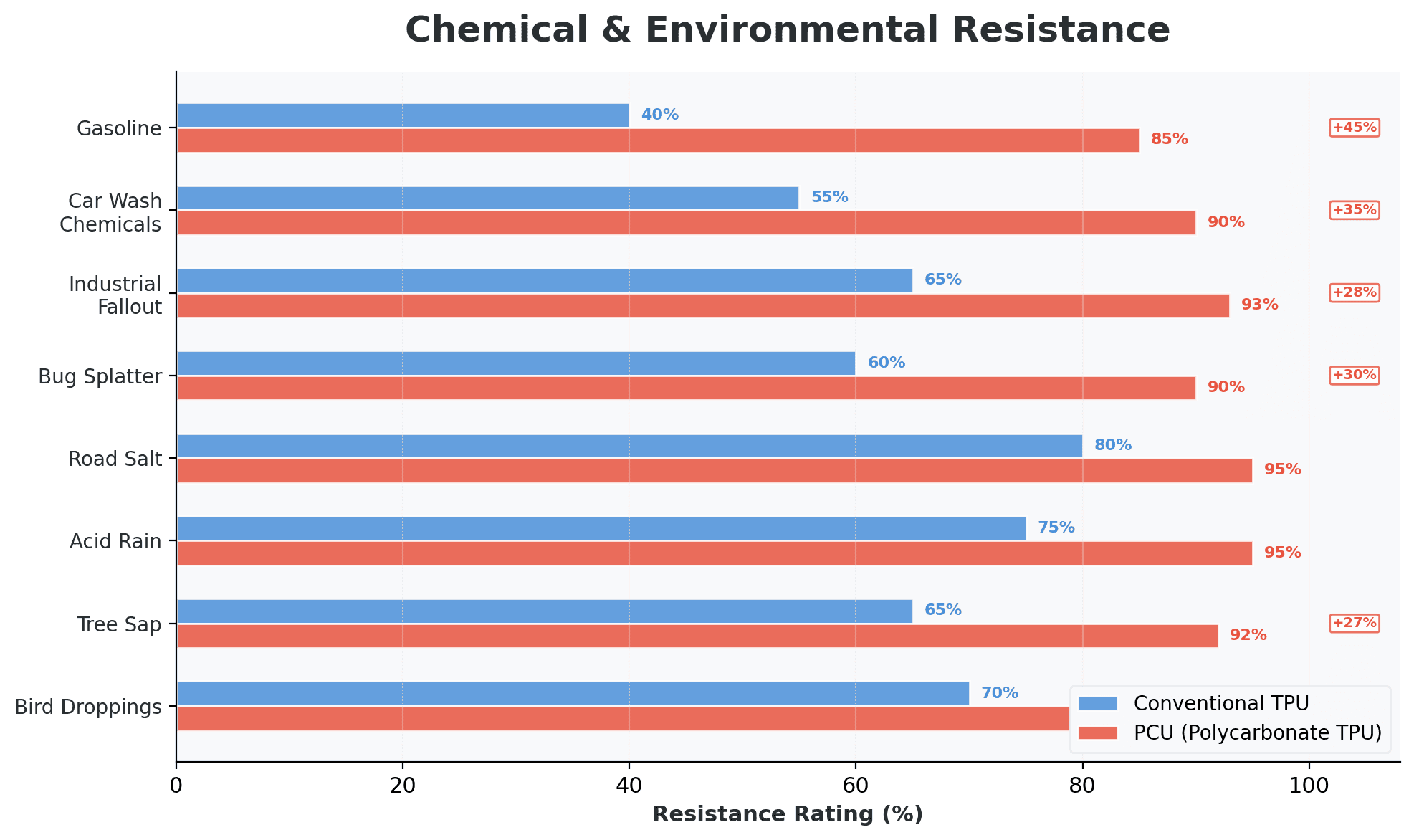
Bird droppings have a pH as low as 3.5. Tree sap contains terpenes that eat through polymer coatings. Acid rain in industrial regions sits at pH 4.0-4.5. Your PPF faces a chemical assault every single day, and most buyers never ask about chemical resistance — because most sellers don’t want to talk about it.
PCU films show 25-35% higher resistance ratings across virtually every common environmental contaminant: bird droppings (95% vs 70% rating), tree sap (92% vs 65%), acid rain (95% vs 75%), and industrial fallout (93% vs 65%). The polycarbonate segments are simply less reactive to organic acids and solvents than urethane linkages alone. If you park outdoors, under trees, or in an urban environment, this single difference could determine whether your PPF lasts five years or fifteen.
The Economic Argument: PCU Costs More Up Front, Then Saves You Thousands
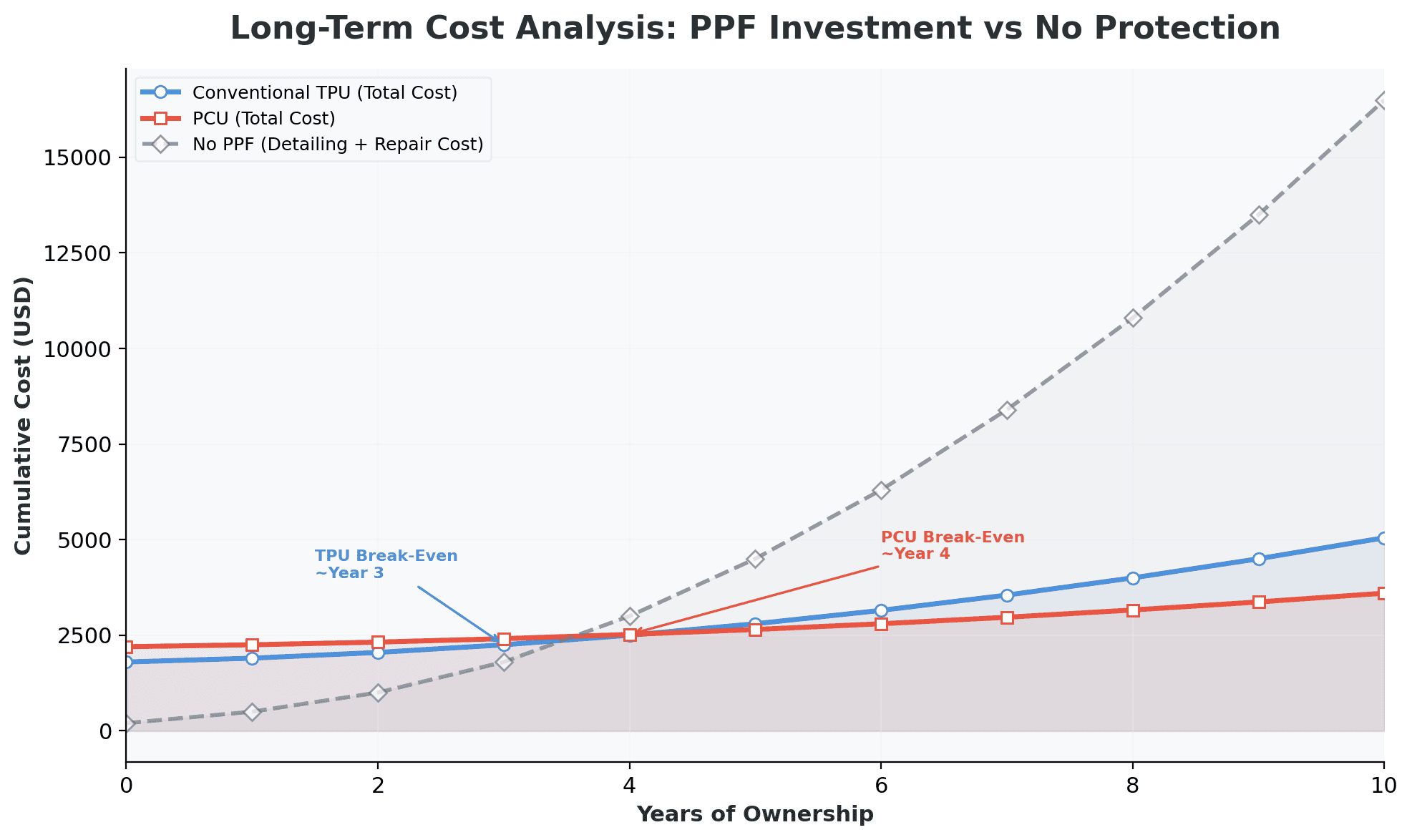
Let’s address the elephant in the room. PCU PPF installation costs approximately 20-25% more than conventional TPU at the point of sale. A full-vehicle PCU wrap might run $2,200 versus $1,800 for TPU. That’s real money. But here’s what the invoice doesn’t show you.
Over a 10-year ownership period, the conventional TPU buyer will likely need film replacement around year 5-7 as yellowing becomes visible and scratches stop healing. That’s a second installation at today’s prices. The PCU buyer? One installation, 10-15 years of service, zero replacement. Add in the detailing and paint correction costs avoided, and the PCU owner comes out approximately $1,400 ahead at year 7 — and the gap only widens from there. The total cost of ownership advantage is not theoretical. It’s arithmetic.
Who Should Still Buy Conventional TPU?
In the interest of intellectual honesty: yes, there are use cases where conventional TPU still makes sense. Lease vehicles with a guaranteed 2-3 year turnover. Budget-constrained buyers who need immediate protection and plan to upgrade later. Markets where PCU distribution hasn’t matured yet. In these narrow scenarios, TPU is a perfectly defensible choice — it is exponentially better than PVC or no protection at all.
But for anyone planning to own their vehicle for 5+ years, or any installer building a reputation on quality, or any distributor competing on performance rather than price alone, the math points in one direction. PCU is not the future of PPF. PCU is PPF now, and everything else is catching up.
SHIELD SPIRIT: The Factory Behind the Film
None of this technology matters without manufacturing excellence behind it. SHIELD SPIRIT operates a 70,000 sqm production facility with two dedicated workshops and over 300 specialized staff. We are not a trading company. We are not a white-label reseller. We are the factory — and that distinction matters when quality control, batch consistency, and production lead times determine whether your business succeeds or fails.
Our OEM/ODM capabilities span the full automotive film portfolio: PCU PPF (our flagship, 7.5-12 mil, glossy and matte, up to 15-year warranty), TPU PPF (various grades for different market segments), Color PPF and Vinyl Wrap (100+ colors, TPU and PVC options), and Nano-Ceramic Window Film (99% IR rejection, 99%+ UV protection). We hold multiple invention and utility patents covering film inspection, adhesive technology, drying equipment, and precision cutting positioning systems. Our 4.95/5 rating from 2,713+ reviews reflects real-world performance, not marketing copy. If you’re ready to discuss OEM/ODM partnership opportunities, our team is equipped to handle projects of any scale.
Frequently Asked Questions
Is PCU PPF worth the extra cost compared to TPU?
For ownership periods exceeding 3-4 years, yes — the math is unambiguous. The 20-25% upfront premium is recovered through avoided replacement costs, reduced maintenance, and superior long-term paint preservation. By year 7, PCU owners are typically $1,000-1,500 ahead of TPU owners on a cumulative cost basis.
Can PCU PPF be installed by any professional installer?
Yes. PCU films install using the same techniques, tools, and slip solutions as conventional TPU. Installers familiar with premium TPU will find PCU’s higher elongation actually makes complex curves easier, not harder, to wrap. SHIELD SPIRIT provides installation training and technical support to all OEM/ODM partners.
Does PCU PPF really last 15 years?
Premium PCU films, when professionally installed and reasonably maintained, have demonstrated 10-15 year effective service life in both accelerated aging tests and real-world deployments. The 15-year figure represents an upper bound under optimal conditions; 10-12 years is a more conservative expectation for daily-driven vehicles in mixed climates. This is still roughly double the realistic lifespan of conventional TPU.
Can I get PCU PPF in matte finish?
Absolutely. SHIELD SPIRIT offers PCU PPF in both high-gloss and premium matte finishes. The matte variant applies the same PCU core layer with a specially formulated matte top coat that preserves the satin aesthetic without sacrificing any of the protection performance.
How do I verify that a PPF is genuinely PCU and not just labeled as such?
Demand material certifications and independent lab test results. Genuine PCU will show FTIR spectroscopy peaks consistent with polycarbonate segments (carbonate C=O stretch at ~1740 cm-1), which are absent in conventional TPU. Reputable manufacturers will provide these reports. If a supplier refuses or deflects, treat that as a red flag. At SHIELD SPIRIT, we provide full material traceability documentation with every OEM/ODM order.
Ready to discuss how PCU PPF can elevate your product line? Contact SHIELD SPIRIT today for OEM/ODM pricing, samples, and technical specifications.