










PCU PPF: The Next Industry Benchmark?
PCU PPF: Why This Material Direction Is Becoming an Industry Benchmark
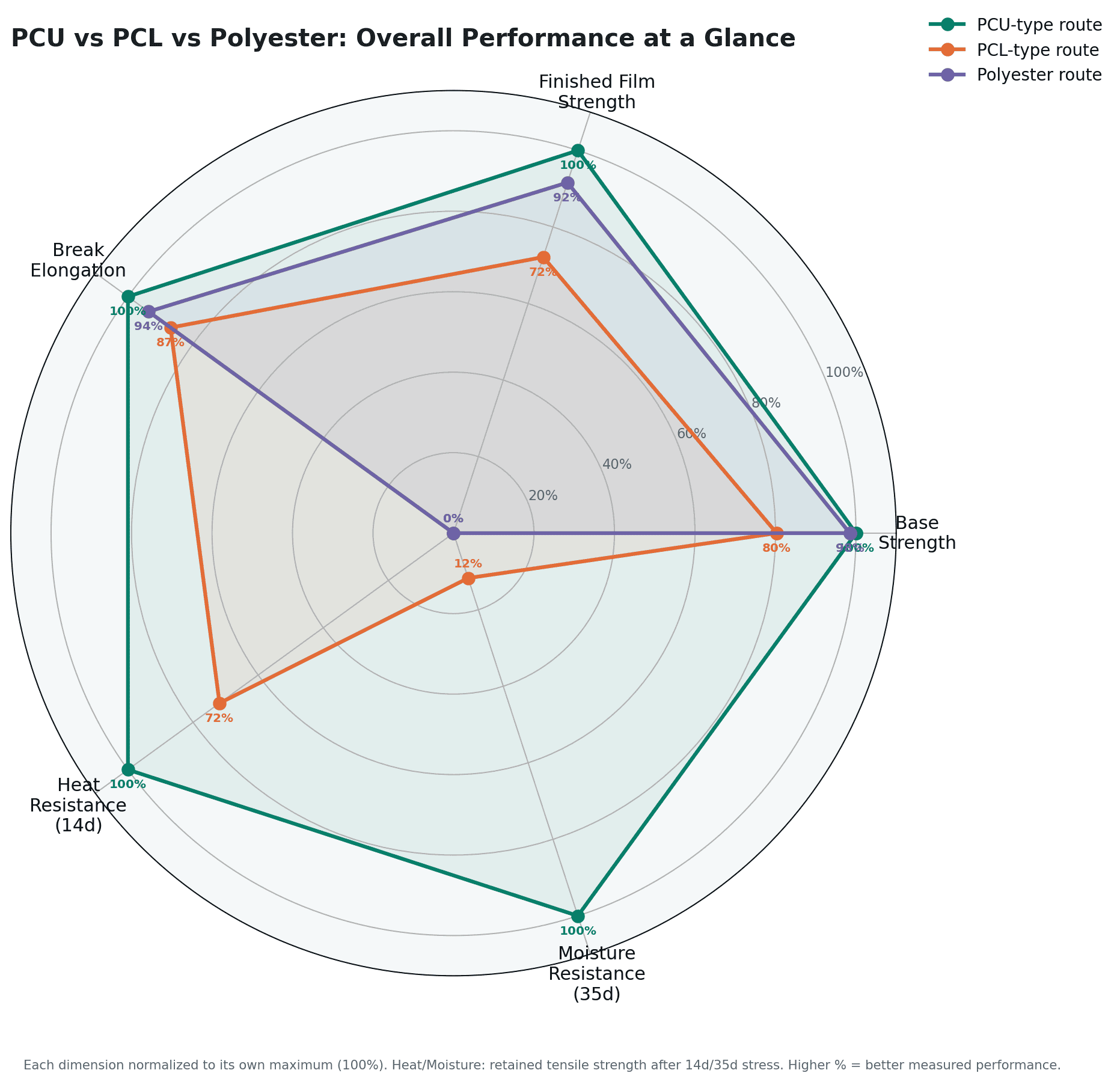
A low price or a glossy installation photo cannot tell you how a paint protection film will behave after months of heat, moisture, sunlight and cleaning. The useful question is what the finished film can still do after stress. In the supplied comparison, the PCU route repeatedly showed the strongest overall direction, which is why it deserves serious attention from car owners, installers and distributors.
This article translates the supplied data into plain language. Supplier names and specific material grades are intentionally omitted. The numbers below belong to defined laboratory samples and must be matched to the exact finished PPF product before they are used as a warranty promise.
What PCU means in everyday language
PCU means a polycarbonate-based TPU material platform (what PCU PPF means in more detail). Think of it as a tough, flexible clear shell: it needs enough strength to resist road abuse, enough stretch to wrap a bumper, and enough stability to keep working after heat and moisture exposure. But PCU is not a magic word. The topcoat, adhesive, stabilizers, thickness, liner, coating process, installation and maintenance all shape the final result.
That complete-system point matters. A strong base film can still disappoint if the adhesive lifts, the topcoat stains, or the installer overstretches an edge. The data tells us where the PCU direction is strong; the finished roll and its documentation determine what the customer actually receives.
The mechanical starting point
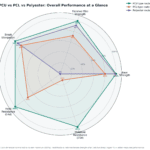
The summary comparison looked at three film routes: a PCU-type route, a PCL-type route and a polyester-type route. The numbers are not one single score. Each column answers a different question.
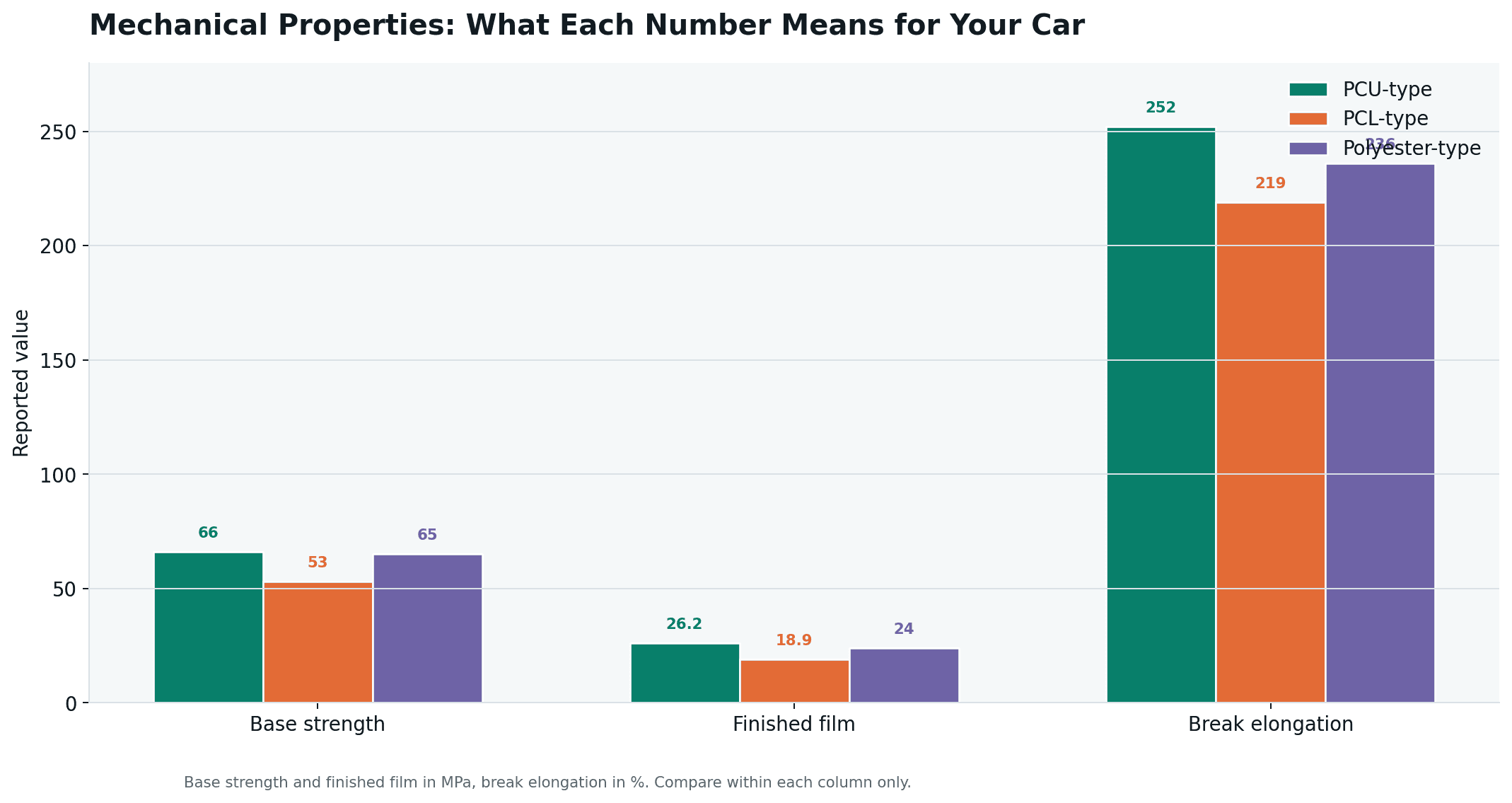
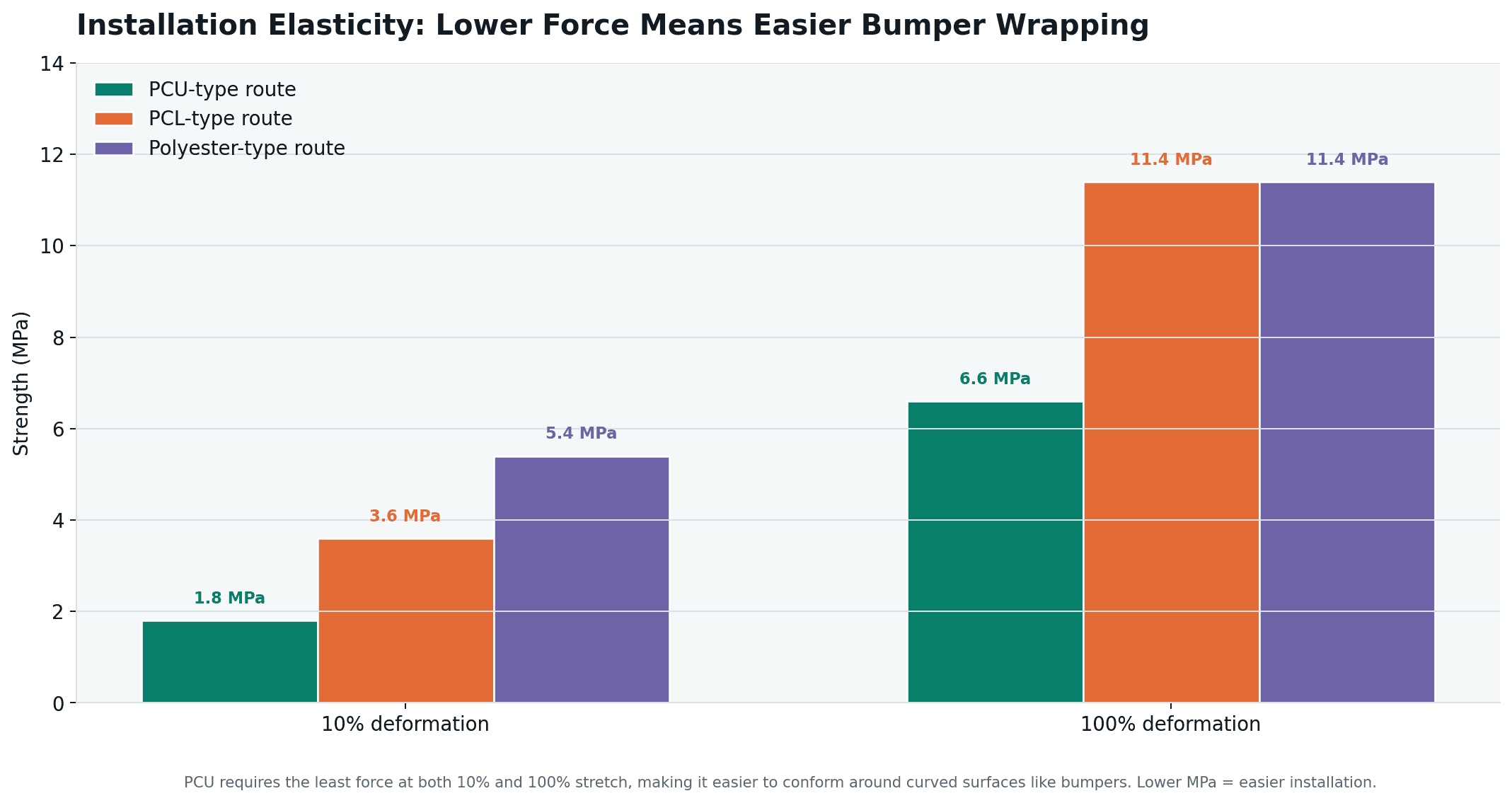
Base-film strength was 66 for the PCU-type route, compared with 53 and 65 for the other two routes. At 10% deformation, the PCU sample needed 1.8 MPa, compared with 3.6 and 5.4 MPa. In plain English, modest stretching required less force in the PCU comparison, which can help the film follow a curved bonnet or bumper instead of fighting the installer.
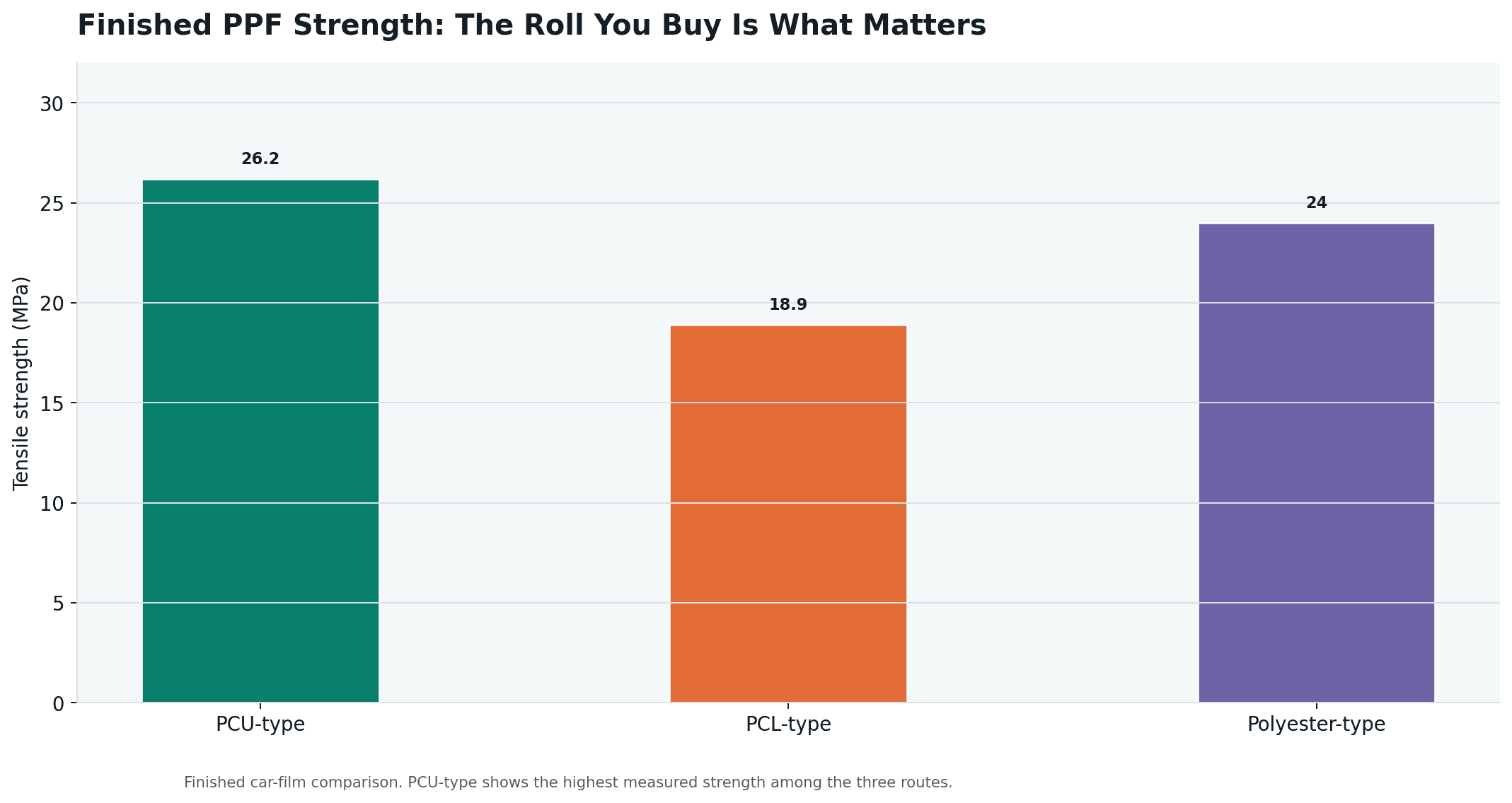
At 100% deformation, the reported values were 6.6 MPa, 11.4 MPa and 11.4 MPa. The finished-film strength comparison then reported 26.2 MPa for the PCU-type route, 18.9 MPa for the PCL-type route and 24.0 MPa for the polyester-type route. Break elongation was 252%, 219% and 236% respectively. These figures describe a practical balance: a film should be workable during installation but should still have useful strength after it becomes a finished product.
Why the installation number matters
Imagine an installer covering a bumper with a deep side curve. If the film needs excessive force before it follows the shape, the installer may create whitening, uneven tension or a stressed edge. The PCU test sample also reported a more detailed strength profile: 1.8 MPa at 10% deformation, 3.2 MPa at 30%, 5.8 MPa at 100% and 36.4 MPa at 300%, with 54.9 MPa tensile strength and 387% break elongation in the 0.15 mm film sample.
That is why “easy to install” should not mean “weak.” The useful target is controlled elasticity: it can conform to the car, while the finished film keeps enough toughness for daily driving.
Hot and humid aging: the clearest gap
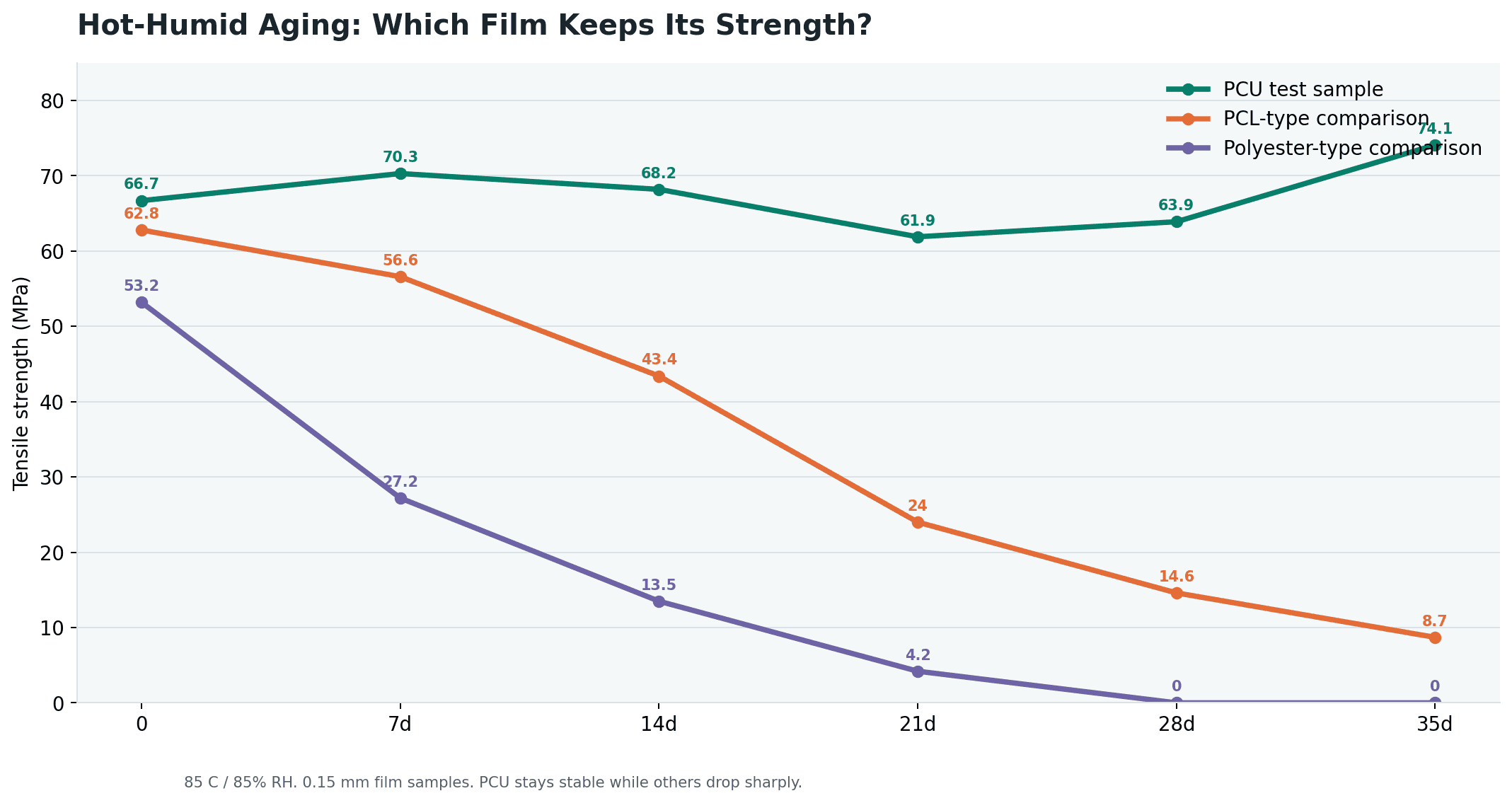
In the supplied 85°C / 85% relative humidity comparison, the PCU test sample moved from 66.7 at day zero to 70.3, 68.2, 61.9, 63.9 and 74.1 through day 35. The PCL-type comparison fell from 62.8 to 8.7 over the same period. The polyester-type comparison also declined sharply, from 53.2 to zero by day 28.
For a car owner, this is not an abstract line chart. It resembles the long-term pressure placed on a film by hot parking lots, humid air, rain, road spray and repeated temperature changes. The PCU line stayed comparatively stable in this supplied stress test, while the comparison lines lost much more measured strength. That is a strong reason to consider PCU for demanding climates, while still checking the exact finished-film construction.
QUV aging: why lower change is useful
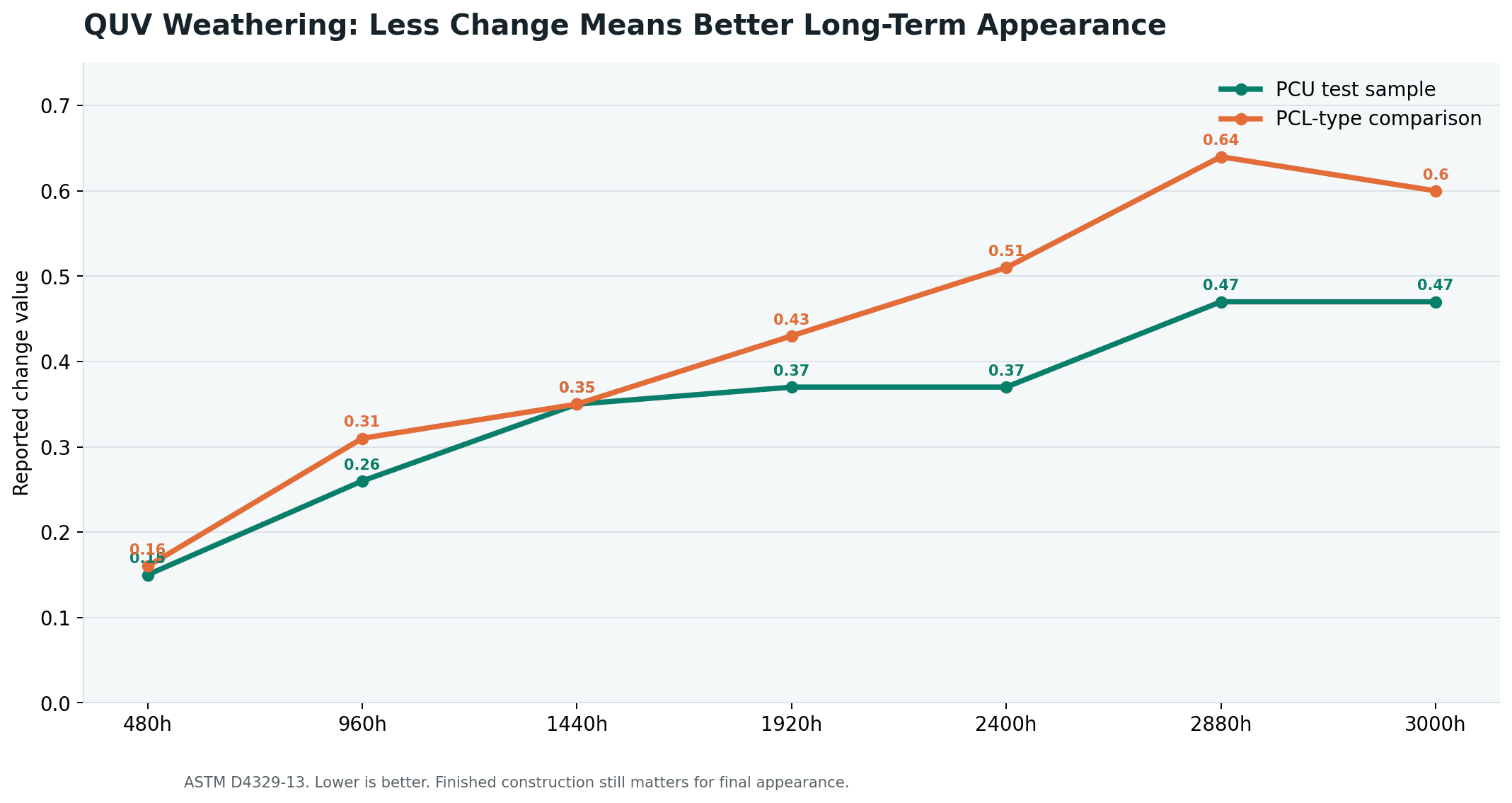
The QUV chart used 480 to 3,000 hours and referenced ASTM D4329-13. The PCU sample values rose from 0.15 to 0.47, while the comparison sample rose from 0.16 to 0.60 at the final point. The practical reading is that the PCU sample showed the lower reported change at most later time points.
Do not turn that into “never yellows” — why no PPF should be sold as a never-yellow promise. Outdoor appearance depends on the whole finished film, sunlight spectrum, surface care, installation and warranty scope. The honest consumer message is simpler: PCU showed the more stable direction in this supplied accelerated-weathering comparison, so it is worth asking for product-level QUV and appearance data.
Heat, acid and alkali stress
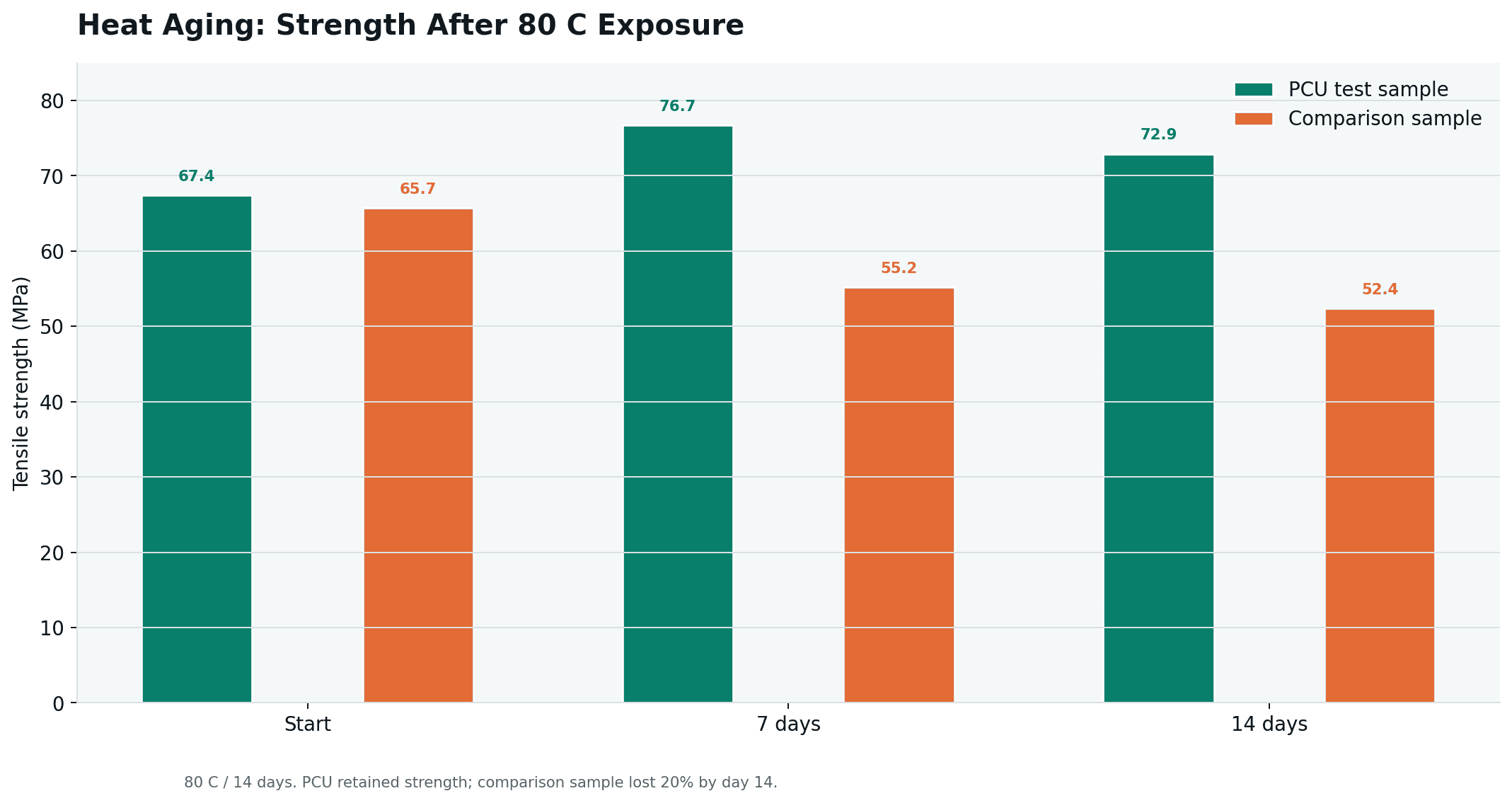
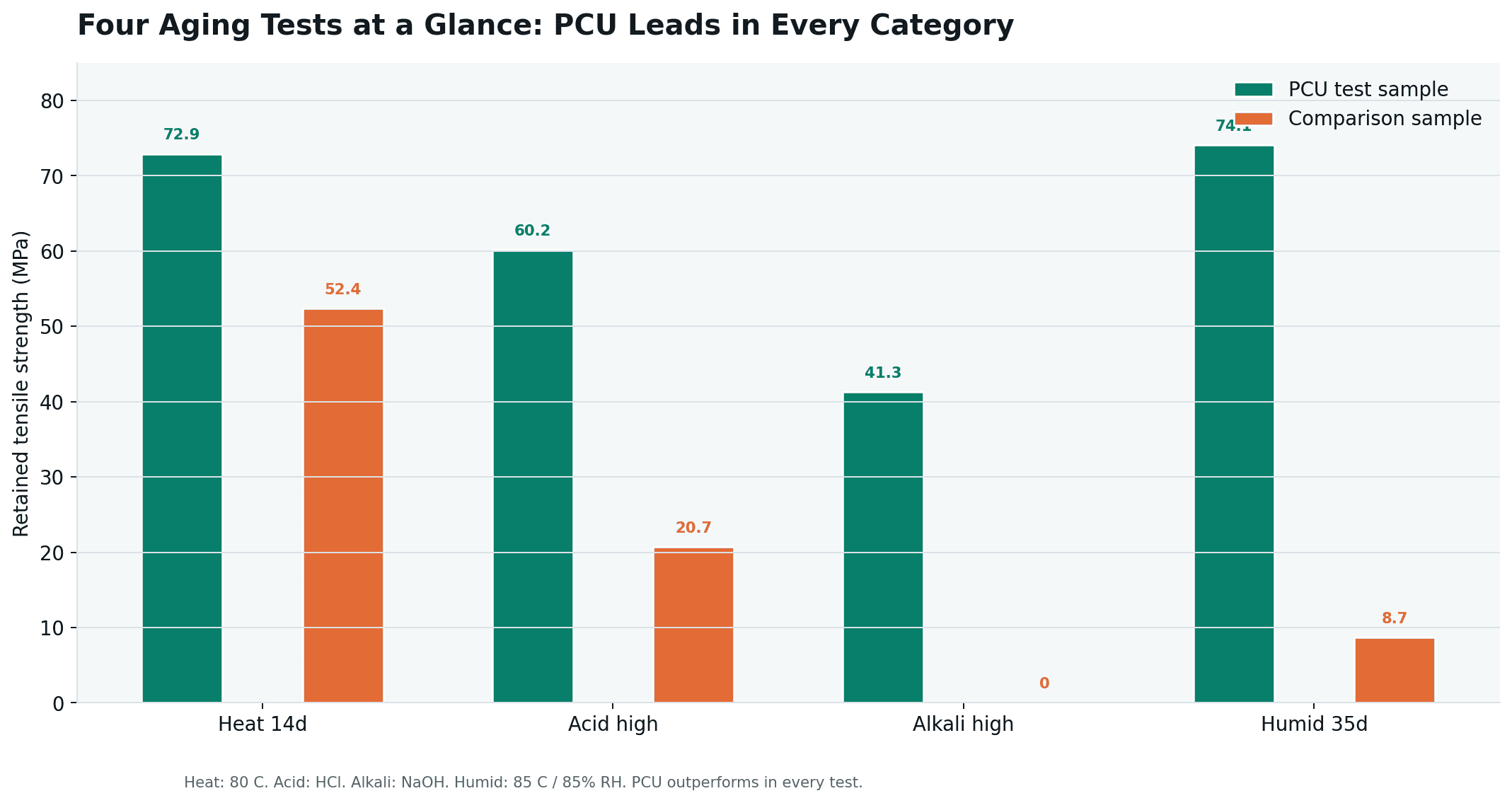
The heat-aging comparison used 80°C for 14 days. The PCU test sample measured 67.4 initially, 76.7 after seven days and 72.9 after 14 days. The comparison sample measured 65.7, 55.2 and 52.4. In a hot market, that suggests the PCU sample retained more measured strength after the stated heat exposure.
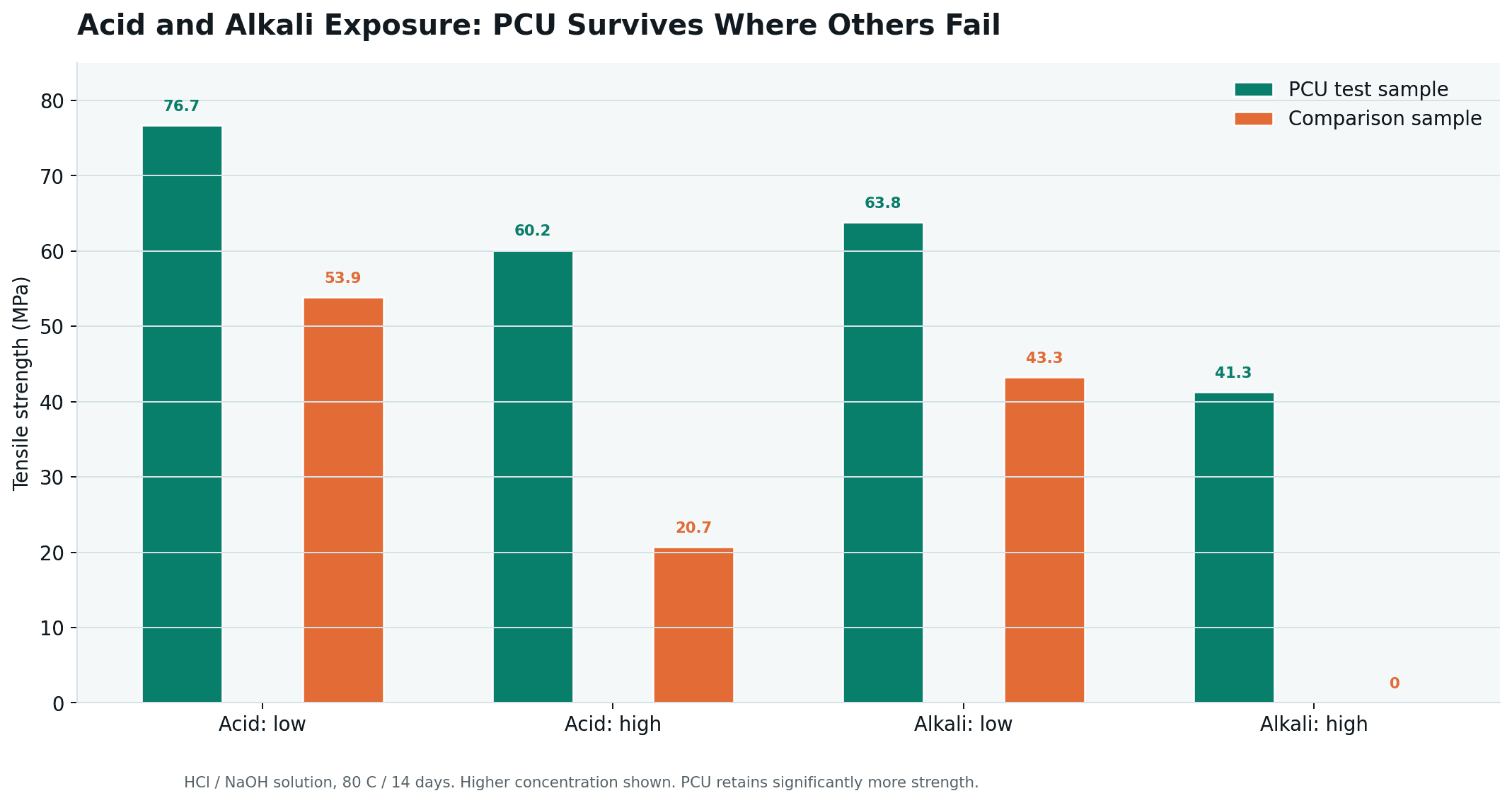
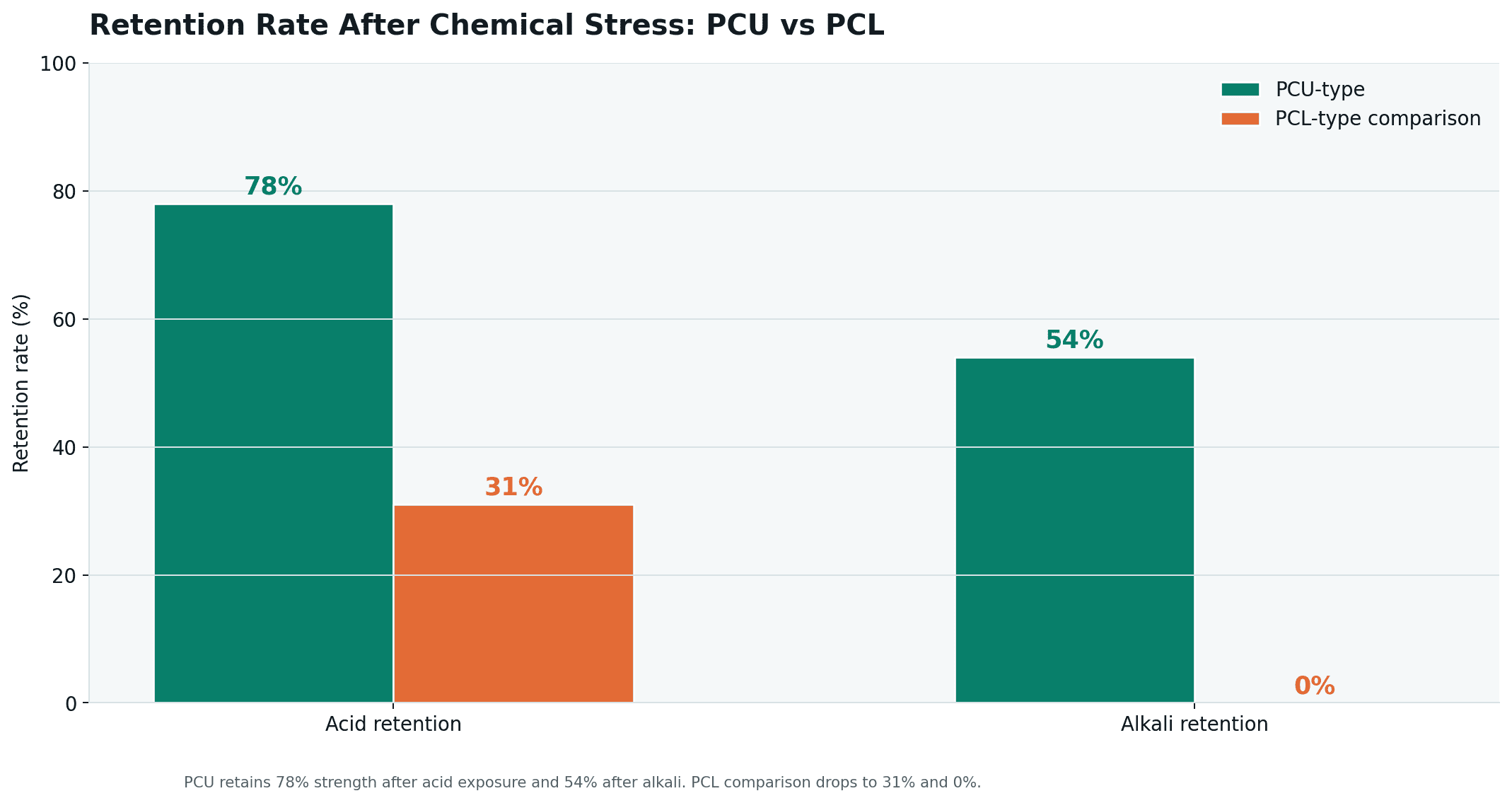
The acid test used HCl solution at 80°C for 14 days. At the higher stated concentration, the PCU sample measured 60.2, while the comparison measured 20.7. The alkali test used NaOH under the same temperature and duration; at the higher concentration, the PCU sample measured 41.3, while the comparison reached zero.
What does that mean for a normal driver? Bird droppings, insects, tree sap and chemical residue should still be cleaned promptly. The chart does not mean every household cleaner is safe. It means the PCU sample kept more strength under the stated laboratory stress, giving the material direction a stronger starting case for real-world product development.
The conclusion: why PCU is the future-facing direction
When the supplied results are read together, the PCU direction combines the qualities buyers usually want at the same time: strong mechanical data, controlled installation elasticity, better retention in hot-humid aging, a lower reported change in the QUV comparison, and stronger results in the stated heat, acid and alkali tests.
That combination is why PCU can reasonably be described as a future industry benchmark direction in the supplied evidence. It is not because one number wins. It is because the material route performs across several different problems that a car owner experiences over time: fitting the film, surviving heat, handling moisture and keeping useful strength after chemical stress.
Why SHIELD SPIRIT focuses on PCU PPF
SHIELD SPIRIT PCU PPF is a main, high-demand product direction for SHIELD SPIRIT. We have manufactured and sold PCU paint protection film for two years, using the material platform as part of a complete PPF system rather than treating it as a standalone resin claim.
For wholesale buyers, SHIELD SPIRIT PCU PPF is available with a minimum order of 10 rolls. Thickness options are 7.5, 8.5, 9.5 and 11.5. The right thickness depends on the vehicle, impact exposure, installation plan and market positioning; thicker is not automatically better for every car.
What buyers should ask before ordering
- Is the data from the base film or the finished PPF?
- Does the sample match the exact thickness, topcoat, adhesive and construction being sold?
- What were the temperature, humidity, duration and chemical concentrations?
- What are the care instructions, installer requirements and warranty limits?
- Can the batch and technical documents be traced to the rolls supplied?
Those questions protect both the car owner and the distributor. They turn “PCU is strong” from a sales slogan into a product decision supported by evidence.
Final view
The supplied comparison points clearly toward PCU as one of the most complete and durable material directions currently available for advanced PPF development. It brings together strength, elasticity and aging resistance in a way that ordinary owners can understand: the film is easier to work with, keeps more of its measured performance after demanding tests, and is better suited to the long ownership cycle that premium vehicles require.
SHIELD SPIRIT welcomes wholesale orders for PCU PPF from 10 rolls, in 7.5, 8.5, 9.5 and 11.5 thickness options. Review the exact construction, test records and warranty with our team before choosing the specification for your market.