








PCU مقابل TPU PPF: تحليل تقني متعمق
Compare PCU and TPU paint protection film technology. Discover why PCU offers 3x better hydrolysis resistance and up to 15-year durability for professional installers and B2B distributors.
What Is TPU PPF and How Does It Protect Vehicle Paint?
The PCU vs TPU PPF debate has become central to paint protection film procurement decisions worldwide. Thermoplastic polyurethane (TPU) paint protection film has been the industry benchmark for automotive surface protection for over a decade. A modern TPU PPF consists of multiple precision-engineered layers: a self-healing clear coat on top, a flexible TPU substrate in the middle, and a pressure-sensitive adhesive layer at the bottom. When properly installed, this multi-layer system absorbs stone chips, resists scratches, and shields factory paint from UV degradation and environmental contaminants.
The global PPF market has grown at a compound annual growth rate of 17.8% from 2020 to 2025, with total shipments reaching approximately 185 million square meters in 2025. This explosive growth reflects rising consumer awareness of long-term vehicle value protection — particularly among new energy vehicle (NEV) owners, whose PPF adoption rate now stands at 37.1% compared to just 12.5% for internal combustion engine vehicles.
However, not all TPU films perform equally. The molecular structure of the soft segment within the polyurethane — the component responsible for flexibility and impact absorption — directly determines how the film ages. This is where PCU technology enters the conversation.
PCU vs TPU PPF: What Makes Polycarbonate Urethane Different?
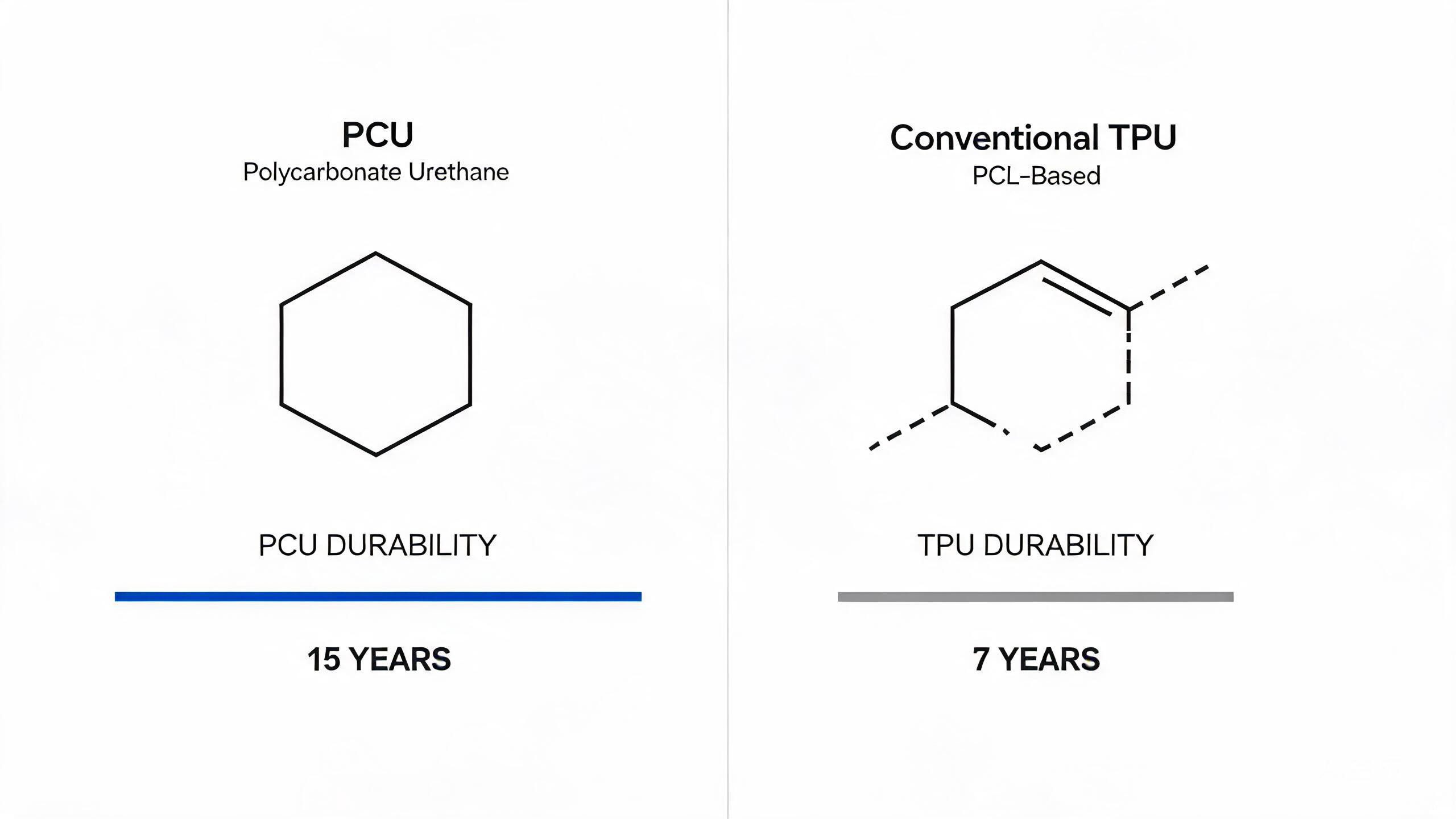
PCU, or polycarbonate urethane, represents a fundamental upgrade to conventional TPU chemistry. In standard TPU films, the soft segment is typically built from polycaprolactone (PCL) — a polyester-based material that delivers good initial flexibility but carries a critical weakness: susceptibility to hydrolysis.
PCU replaces the PCL soft segment with polycarbonate-based molecular chains. This substitution changes how the material interacts with water at the chemical level. While PCL ester bonds gradually break down when exposed to moisture over time — a process called hydrolysis — polycarbonate bonds remain structurally stable even under prolonged humidity, rain, and washing conditions. This is why SHIELD SPIRIT’s PCU-based PPF formulations are engineered specifically for tropical and coastal markets where conventional films fail prematurely.
Hydrolysis Resistance: The Critical Difference That Determines Film Life
Hydrolysis is the number one cause of long-term PPF failure. When TPU films absorb ambient moisture, water molecules attack the ester linkages in the polymer backbone. Over years, this chemical degradation manifests as yellowing, embrittlement, cracking, and delamination — all catastrophic failures that lead to warranty claims and reputational damage for installers and distributors.
Independent laboratory testing demonstrates that PCU offers approximately three times the hydrolysis resistance of conventional TPU. SHIELD SPIRIT subjects every PCU film batch to a 10-week continuous water immersion test — far exceeding standard industry protocols — to verify hydrolysis resistance before release. The results are consistent: PCU films maintain their optical clarity, tensile strength, and elongation properties long after conventional TPU samples show measurable degradation.
- Conventional TPU (PCL-based): Ester bonds vulnerable to moisture attack; gradual yellowing begins at 3–5 years in humid environments
- PCU (Polycarbonate-based): Carbonate bonds resist hydrolysis; negligible degradation even after 10+ years of real-world exposure
- SHIELD SPIRIT testing protocol: 5,000-hour QUV accelerated aging + 10-week water immersion + 48-hour post-production aging
For distributors serving markets in Southeast Asia, the Middle East, Latin America, and coastal regions, the hydrolysis advantage of PCU translates directly into fewer warranty claims, higher customer retention, and stronger brand reputation.
Self-Healing Performance: A Side-by-Side Comparison
Both PCU and premium TPU films feature self-healing top coats that recover from light scratches and swirl marks when exposed to heat. The healing mechanism relies on the viscoelastic properties of the clear coat layer: polymer chains reflow to fill micro-scratches when the surface temperature rises above approximately 40°C (104°F).
However, the latest generation of self-healing technology — showcased by BASF at the 2025 European Coatings Show — uses hydrogen-bond self-assembly to achieve room-temperature scratch recovery in under five seconds. PCU films, with their more stable molecular architecture, are better positioned to integrate these advanced top-coat technologies because the substrate and coating layers work synergistically rather than independently.
In practical terms, this means:
- Heat-activated healing (both TPU and PCU): Swirl marks disappear under sunlight, warm water, or a heat gun in 30–60 seconds
- Ambient-temperature healing (advanced PCU with 3rd-gen top coats): Micro-scratches recover at room temperature without external heat
- Healing durability: PCU films retain self-healing capability for more cycles because the substrate does not yellow or stiffen over time
Durability, Warranty, and Real-World Lifespan
The extended molecular stability of PCU translates into measurably longer service life. While premium conventional TPU films carry 5–7 year manufacturer warranties, PCU films are warrantied for 10–12 years — with SHIELD SPIRIT’s flagship PCU series engineered for up to 15 years of real-world performance.
Key durability metrics from SHIELD SPIRIT’s in-house testing — conducted in ISO-classified dust-free production workshops across our 70,000 sqm facility:
- Temperature tolerance: -40°C to +120°C (-40°F to +248°F), covering extreme winter conditions and desert summer heat
- Thickness options: 7.5 mil, 8.5 mil, 9.5 mil, and 12 mil — accommodating everything from daily-driven sedans to off-road commercial vehicles
- UV protection: 99%+ UV blockage, verified through 5,000-hour QUV accelerated aging with zero yellowing
- Optical clarity: < 1% haze after accelerated aging, maintaining the factory paint’s depth and gloss
These metrics are not marketing claims — they are batch-verified through documented quality control protocols with complete traceability from raw material to finished roll, backed by over 60 patents in film defect detection, coating formulation, and production equipment.
Installation Characteristics: What Professional Installers Need to Know
From an installer’s perspective, PCU films offer distinct handling advantages over conventional TPU. The polycarbonate soft segment makes the film softer and more pliable at working temperatures, which means easier manipulation around complex body curves, bumper contours, and mirror housings. For installation teams transitioning to a new film lineup, OEM partners that provide hands-on training and technical documentation can reduce the learning curve from weeks to days.
| Installation Factor | Conventional TPU | PCU (Polycarbonate Urethane) |
|---|---|---|
| Stretchability | Good (180–220% elongation) | Excellent (220–280% elongation) |
| Curve Conformity | Requires heat for tight radii | Conforms with less heat; reduced stress marks |
| Adhesive Repositioning | Standard repositioning window | Extended working time; forgiving for novice installers |
| Edge Lifting Risk | Moderate (substrate stiffening over time) | Low (substrate remains flexible throughout service life) |
Installation best practices remain consistent regardless of film type: a dust-free cleanroom environment, thorough paint decontamination with clay bar treatment, and precision edge wrapping into panel gaps are non-negotiable for professional results.
Cost vs. Value: Making the Right Inventory Decision for Your Business
PCU PPF commands a higher wholesale cost per roll than conventional TPU — typically 20–30% more at the B2B level. For distributors weighing this premium, the value equation must account for total cost of ownership, not just upfront unit price.
Consider the downstream economics:
- Warranty claim reduction: One SHIELD SPIRIT distributor, AutoShield Group (USA), reported a 25% reduction in warranty claims after switching to PCU-based films — directly improving net margins
- Customer lifetime value: A 10–12 year warranty builds long-term customer relationships and generates repeat business through brand loyalty, whereas shorter-lived films create one-time transactions
- Market positioning: PCU allows distributors and installers to differentiate in an increasingly competitive market, commanding higher installation prices and premium brand perception
- Reduced rework costs: Easier installation characteristics mean fewer re-dos and less material waste per vehicle
The smart inventory strategy for most distributors is a tiered portfolio: stock conventional TPU for price-sensitive segments and PCU for premium customers who demand the best protection available. This mirrors how the wider automotive aftermarket segments products across good-better-best tiers.
Conclusion: Which PPF Technology Should You Stock?
The PCU vs TPU PPF question ultimately comes down to your target market and brand positioning. If you serve price-driven markets where the primary selling point is affordability, conventional TPU remains a viable option. But if your customers demand maximum durability, minimum warranty issues, and premium performance — particularly in harsh climates — PCU is the clear winner.
SHIELD SPIRIT has built its manufacturing infrastructure around PCU as the flagship technology because we believe the long-term value proposition is irrefutable. With 60+ patents, 70,000 sqm of production facilities, 300+ staff, and exports to 70+ countries, we support distributors with factory-direct pricing, flexible OEM/ODM customization, and low 10-roll MOQ for market testing. Request technical specifications and sample rolls to evaluate PCU film performance for your specific market conditions.